Who Watches the World's Watchers?
Israel's Reach into Global Digital Infrastructure
2026-11-21 · A.F. Sadek

Arabic edition: Read in Arabic
On October 15, 2026, Citizen Lab published the first public technical confirmation of an attack that infected devices inside the Al Jazeera network with commercial spyware through targeted advertisements. Victims did not have to click an ad or download a file. The ads were bought by the Israeli company Discover-Tech, and the spyware came from the Israeli firm Candiru, while Discover-Tech sat quietly on Google's "approved" vendor lists. [15]

The attack exploited ad auctions that run in fractions of a second to decide which advertisement appears on your screen. In these auctions, bidders can receive data such as your location, IP address and device identifier.
That same day, October 15, 2026, TrendAI researchers published a report on an actor using these auctions under a code name. On October 27, six sources told Reuters that the actor was Discover-Tech.
According to the report, that actor won the largest share of observed ad auctions targeting Starlink users across 105 countries. Starlink is SpaceX's satellite internet service. Across the broader sample of observed ad auctions in Egypt overall, the actor accounted for 77.2%. [16]
This investigation starts twenty years earlier, inside a wiretapping room at an AT&T building in San Francisco, and reaches a contract filed with the US Justice Department that lists shaping GPT answers among the goals of a paid campaign.
Between those two cases, the investigation traces Israeli reach across global digital infrastructure: from phones and telecom networks to the keys to bank and cloud systems, and from the battlefield to what you read online and what the machine tells you.
1. From the Wire to the Phone in Your Pocket
Inside AT&T's San Francisco building, copies of communications traffic were routed into Room 641A for the US National Security Agency. Mark Klein, a former technician at the company, gathered documents showing how that traffic reached the room and which machines ran inside it. Among them was a network traffic analyzer built by Narus, a company founded by Israeli entrepreneurs in 1997. [1]

Narus appeared in Egypt as well. In 2011, WIRED reported that the company had sold internet traffic inspection equipment to Telecom Egypt under Hosni Mubarak. [1]
In June 2013, documents leaked by Edward Snowden, who worked for an NSA contractor, revealed part of the scale of this surveillance. Early reports showed that the agency was collecting phone records of millions of Americans and exposed the PRISM program for gathering data from major internet companies. [2]
Israel's role inside that system came to light that September, when The Guardian published another Snowden document: a memorandum of understanding between the NSA and Israel's signals intelligence unit (ISNU), agreed in principle in March 2009. Under it, "NSA routinely sends ISNU minimized and unminimized raw collection": raw communications not filtered first to remove American citizens' data, including transcripts, metadata and content. The memorandum allows Israel to retain files identifying Americans for up to a year. [2]
One Phone, Two Spyware Tools
In December 2021, Citizen Lab revealed that the phone of exiled Egyptian opposition politician Ayman Nour, living in Turkey, had been hacked with two spyware programs. Researchers detected traces of Pegasus, made by the Israeli firm NSO Group, dating back to March 2021, and then Predator. On June 22, 2021, both programs were running on the same phone at the same time. [3]
In September 2023, Citizen Lab documented an attempt to target Ahmed Eltantawy, then a prospective presidential candidate, with Predator. In that case, attackers tampered with his internet connection over his mobile network using a device made by Sandvine. [3]
Predator was developed by Cytrox, which has had two companies registered in Israel since 2017. It is part of the Intellexa alliance founded by Tal Dilian, a former commander of Unit 81 in the Israeli military, according to Forbes as cited by Citizen Lab.
When Citizen Lab analyzed Predator's iPhone code, it found a check that halts execution if the phone's region is set to Israel or its phone number begins with Israel's country code, +972, though researchers could not confirm whether the program actually invokes that check in practice. [3]
Global Surveillance
Pegasus reached the phone of a member of the committee investigating its use. In July 2026, Citizen Lab announced that forensic analysis of the phone of Greek journalist and former European Parliament member Stelios Kouloglou showed Pegasus infections in October 2022 and March 2023. On both occasions, Kouloglou was an alternate member of the European Parliament's PEGA committee, tasked with investigating the use of Pegasus and similar spyware tools.
Citizen Lab assessed that the compromise could have given the attackers access to non-public information about the committee's work, while it found no indications that the Greek Government is responsible. [4]
In Serbia, Citizen Lab and the SHARE Foundation documented the Pegasus infection of a student activist's phone in a report published in September 2026. In October, Citizen Lab revealed that the phone of University of Belgrade rector Vladan Djokic had been hacked with the same spyware. By the October report, at least 16 members of Serbian civil society were publicly known to have been targeted or infected with commercial spyware. [5]
Beyond individual handsets, in April 2026 Citizen Lab's report "Bad Connection" uncovered two location-tracking campaigns exploiting 3G and 4G signaling protocols and SIM cards. Researchers traced activity tied to telecom operators in Israel, the United Kingdom, Jersey and other countries. The identity of the operator behind each campaign remained unknown. [6]
Some governments and courts moved in response to this spread. In November 2021, the US Commerce Department placed NSO Group and Candiru on its Entity List for trade restrictions, stating that the two companies supplied foreign governments with spyware used against journalists, officials and activists. The following month, Meta banned seven surveillance-for-hire firms from its platforms, four of them founded or based in Israel. In 2022, Norway's sovereign wealth fund excluded Cognyte on the advice of its Council on Ethics, which documented sales of interception systems to entities linked to serious abuses. In March 2024, the US Treasury sanctioned Dilian and several companies tied to Intellexa and Cytrox. [3]
WhatsApp and its parent company Meta sued NSO Group for using WhatsApp's service to hack users' phones with Pegasus. In May 2025, a jury ordered NSO to pay the two companies about $167.7 million, most of it punitive damages meant to punish the company's conduct. In the final judgment issued on November 12, 2025, the court reduced the punitive award, bringing the total owed to $4,447,190 (about $4.45 million), and issued a permanent injunction barring NSO from targeting WhatsApp. [7]
The Official Gateway to the Spyware Market
The Israeli state enters the commercial spyware market through an official gateway: export licensing, held by the Ministry of Defense. Cellebrite states in its annual report that "the export of some of our products and our solutions is subject to Israeli export control laws," administered primarily by the Defense Export Controls Agency (DECA) in the ministry. [3]
Even when no spyware enters a phone, similar reach appears in what a vendor imposes on your device or network. Since 2022, Samsung has placed the AppCloud application on Galaxy A and Galaxy M phones in West Asia and North Africa. The app recommends other apps to download, and the Lebanese organization SMEX links it to ironSource, a company founded in Israel that became part of US-based Unity. In February 2025, SMEX reported that the app is installed without explicit user consent and that it found no publicly posted privacy policy. According to SMEX, full removal requires root access, and even when disabled, the app can reappear after a system update. In May, SMEX called on Samsung to publish the app's privacy policy and allow its removal. In November, Samsung told SamMobile that it protects user data and complies with local laws. All this happens in a region where some countries bar dealings with Israeli companies by law, as Lebanon has done since 1955. [12]
Controlling the Network and the People
In Palestine, control extends to the entire network. Israel requires prior approval before Palestinian telecom operators can obtain frequencies and import equipment. In 2016, the World Bank described the performance of the Joint Technical Committee established under the Oslo accords as "inadequate and ineffective": Palestinians waited eight years until November 2015 for a limited 3G agreement, while Israeli operators had deployed 3G since 2004. The World Bank estimated Palestinian mobile sector revenue losses at between $436 million and $1.15 billion over three years (2013 to 2015). [13]
In Gaza, the only fiber-optic cable connecting the Strip to the outside world runs through Israel. After October 2023, Access Now documented that 15 of Gaza's 19 internet providers were shut down by October 31 due to bombardment, electricity restrictions and technical disruptions. [13]
Even more telling is what Human Rights Watch reported on November 15, 2023 from the Palestinian telecom company Paltel: "when service was restored without our intervention, it was quite clear that these disruptions resulted from deliberate actions perpetrated by Israeli authorities, and it happened twice afterwards." Earlier, on October 17, Israel's Communications Ministry had announced "an ongoing examination and preparation for the shutting down of cellular communications and Internet services to Gaza." Asked about cutting communications as the ground offensive began, Israel's chief military spokesperson answered, as quoted by HRW: "We do what we have to do to secure our forces for as long as we must, temporary or permanent, as much as we need to and we will not say anything further about that." [14] Whoever holds the network decides when it goes dark.
2. The Keys We Pay For
Broader influence needs no hacking at all. Global institutions pay billions of dollars to cybersecurity firms and voluntarily open the deepest doors inside their own networks.
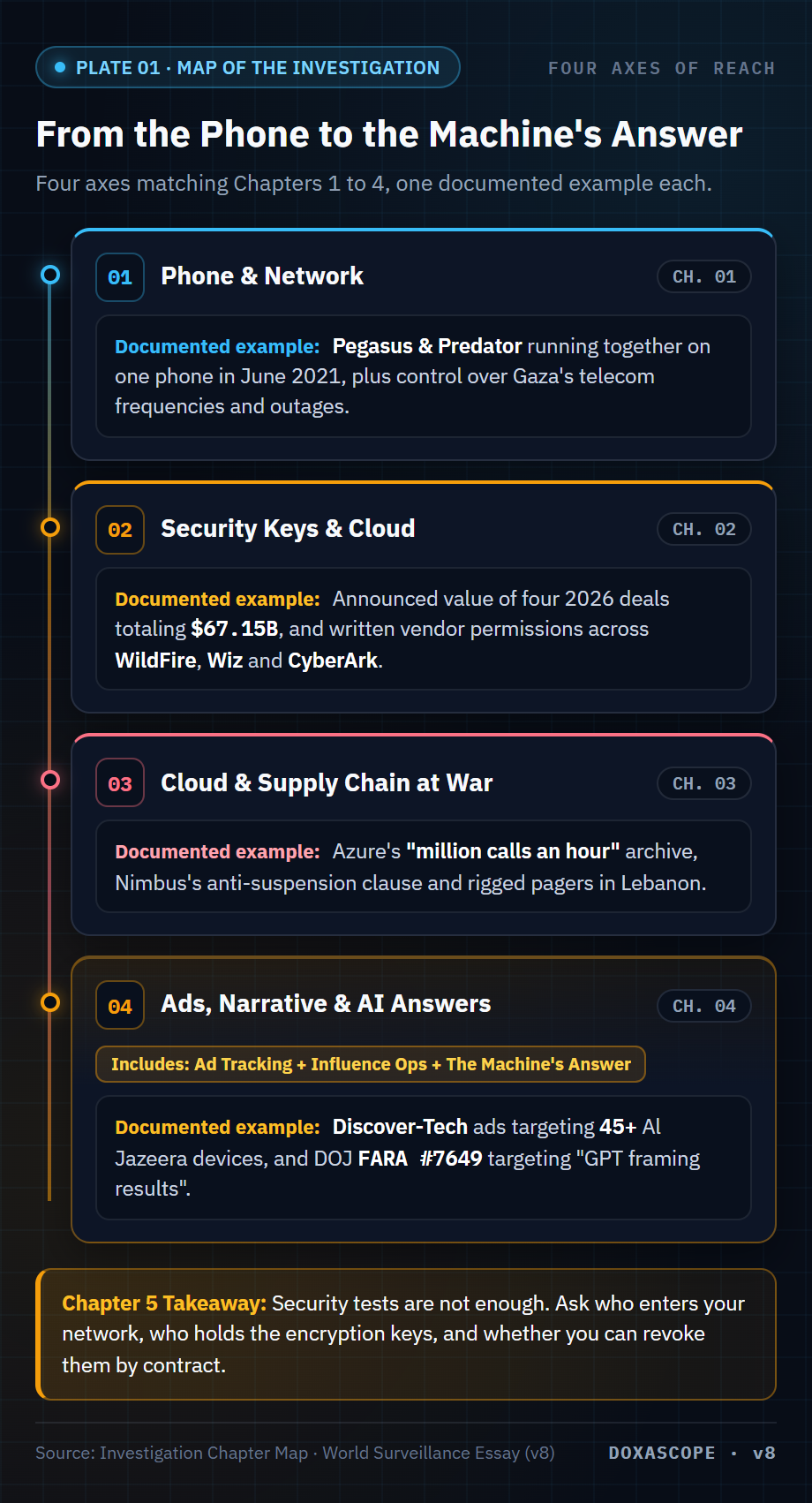
In 2026 alone, the announced value of four acquisitions of cybersecurity companies with Israeli roots reached $67.15 billion: Google closed its purchase of Wiz for cloud security, Palo Alto Networks closed its purchase of CyberArk for privileged account management, ServiceNow closed its purchase of Armis for connected-device monitoring, and Visa signed an agreement to buy BioCatch, which analyzes user behavior in banking transactions, pending approvals. [8]
This industry brings together close-knit networks in which Israel's intelligence Unit 8200 recurs again and again: Palo Alto founder Nir Zuk, Check Point co-founder Shlomo Kramer and Wiz co-founder Assaf Rappaport all served in it, and Check Point has been led since December 2024 by former Unit 8200 commander Nadav Zafrir. According to an Israel Innovation Authority and Dealroom report, Israeli firms attracted about 21.4% of global deep-tech venture capital funding for cybersecurity between 2019 and 2025. Some 43.1% of Check Point's employees work in Israel, and Palo Alto Networks and Check Point both confirm in annual filings that engineers and executives were called up for reserve duty during the 2024 to 2026 conflicts. [9] The same people move across major deals: Wiz's founders earlier built Adallom, bought by Microsoft in 2015, after which Rappaport led Microsoft's Cloud Security group and its development center in Israel. In 2020, the same team founded Wiz, which Google bought. [9]
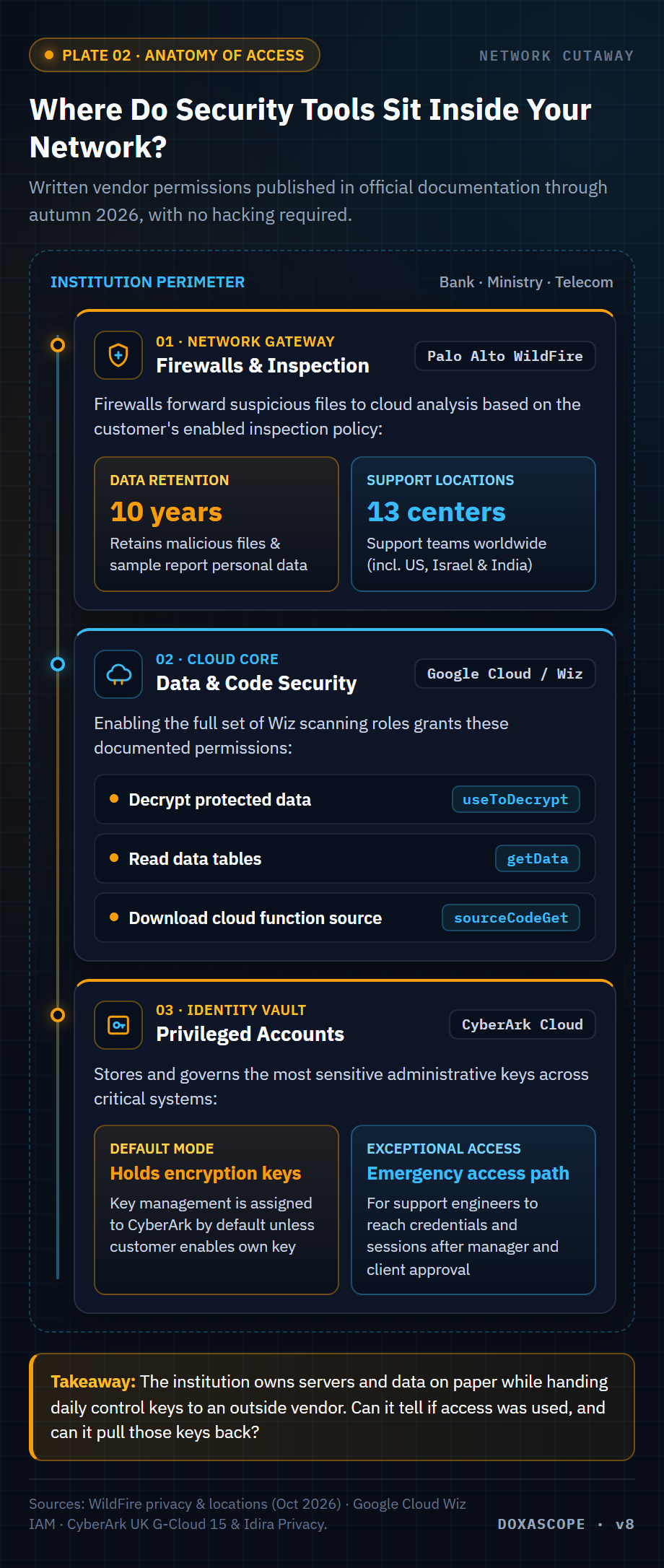
When an institution places a security tool at the core of its network, it grants the supplier written permissions stated in official documents, as of fall 2026:
- What does the company keep, and for how long? Palo Alto Networks firewalls forward suspicious files to its WildFire cloud according to the customer's enabled inspection policy, where malicious files and personal data in sample reports are kept for 10 years. Support files can be accessed by teams operating across 13 support centers worldwide, including centers in the United States, Israel and India. [10]
- What can the platform read? When a customer activates the full set of scanning roles for Wiz on Google Cloud, it grants Wiz permission to decrypt protected data, read data tables and download the source code of cloud functions. [11]
- Who holds the keys to the vault? In CyberArk's cloud service managing sensitive administrative accounts, encryption key management is assigned to CyberArk by default unless the customer enables its own key, and the privacy documentation sets out an emergency access path for support engineers to credentials and session recordings after approval from a manager and the customer. [11]
None of this is secret. Every line is published in company documentation, and every permission carries conditions. In practice, the implication is straightforward: an institution owns its servers and data on paper while handing daily control keys to an outside supplier that may be acquired or fall under another country's law.
Even when ownership passes to an American fund, the engine stays in place. In December 2024, US private equity firm AE Industrial acquired Paragon, developer of the Graphite phone spyware. Yet audited financial statements filed with the US Securities and Exchange Commission show that in 2025 its Israeli segment generated 76.6% of total group revenue, while the group kept 84.6% of its long-lived assets inside Israel. [11] The same pattern holds in cybersecurity: Petah Tikva-based CyberArk employed 1,205 R&D staff and contractors, most of them in Israel, and after acquiring it Palo Alto Networks announced an expansion of its Israeli operations. [8] An American flag on ownership papers did not move the engine.
3. When the Cloud and Supply Chain Become Weapons: "A Million Calls an Hour"
In war, commercial cloud infrastructure and consumer technology shift from protecting institutions to managing battlefields and targeting.
In August 2025, The Guardian, +972 Magazine and Local Call revealed that Unit 8200 stored on Microsoft's Azure cloud recordings of millions of phone calls made daily by Palestinians in Gaza and the West Bank, under an internal mantra: "A million calls an hour." Unit sources said the archive helped prepare deadly airstrikes. On September 25, 2025, Microsoft announced that it had ceased and disabled subscriptions for a unit within Israel's Ministry of Defense, and The Guardian cited intelligence sources saying the unit planned to move its data to Amazon. [17]
On November 16, 2026, The Guardian published a new investigation revealing that an Israeli military software unit named "Rolling Stone" moved the population registry of Gaza and the West Bank into an isolated Amazon cloud region in Tel Aviv and, in early 2024, uploaded roughly 3.5 million images of Palestinians to Amazon to run a facial-recognition tool alongside checkpoints in Gaza, while Israeli soldiers worked directly from the 28th floor of Amazon's Tel Aviv offices. The report recalled a clause in the $1.2 billion Nimbus contract with Google and Amazon that prevents both companies from suspending or restricting services to the Israeli government and military, even if usage violates terms of service. [17]
Local companies also sit between the US supplier and government ministries: a 2023 Amazon study notes that Israel's Malam Team "provides IT solutions that enable other AWS Partners to offer their own solutions to government ministries under the existing Nimbus framework," even though The Guardian investigation does not mention it. [17] The contrast between the two contracts is decisive: on Azure, Microsoft was able to cut off specific services; under Nimbus, the Israeli government stripped the companies of the right to say "no" inside the contract itself.
The cloud's role went well beyond storage. In February 2025, an Associated Press investigation using internal company data revealed that Israeli military usage of AI tools from Microsoft and OpenAI jumped in March 2024 to nearly 200 times its pre-October 7 level, while data stored on Microsoft servers doubled past 13.6 petabytes by July 2024. The military told AP that analysts use AI-enabled systems to help identify targets, that the tools "make more targets faster, but not at the expense of accuracy," and that an Arabic-speaking reviewer checks translations; yet an intelligence officer confirmed seeing targeting mistakes driven by "incorrect machine translations from Arabic to Hebrew." OpenAI said it has no partnership with the Israeli military, and Microsoft declined to comment on that story. [17]
Alongside US tools, Unit 8200 ran domestic systems. In April 2024, +972 and Local Call published testimonies from six intelligence officers on the AI system Lavender, which, according to four of them, listed roughly 37,000 Palestinian men as potential targets early in the war, while the Israeli military described it as an intelligence cross-referencing database and "not a list of confirmed military operatives eligible to attack." [17]
Earlier, in March 2024, The New York Times (as summarized by AFSC and AOAV) exposed a facial-recognition pilot used by military intelligence in Gaza relying on Israel's Corsight AI alongside Google Photos, documenting misidentifications that led to the detention of civilians including Palestinian poet Mosab Abu Toha. The same Corsight technology later surfaced on British streets: in July 2025, AOAV documented Essex Police admitting that Corsight software is integrated into facial-recognition systems supplied by UK contractor Digital Barriers. [18]
When these capabilities reach beyond Palestine, they become direct instruments of electronic operations and strikes:
- Navigation jamming (
GPS). On March 22 and July 24, 2024 (the second letter was circulated on July 31 and covered by the press in August), Lebanon submitted complaints to the UN Security Council and Secretary-General accusing Israel of jamming and spoofing GPS navigation systems and endangering civil aviation over Beirut's Rafic Hariri Airport, while the Los Angeles Times and L'Orient Today documented widespread spoofing across northern Israel and Lebanon that placed phones and aircraft far from their true locations. [19] - Tehran's cameras. On February 28, 2026, Iranian supreme leader Ali Khamenei was killed in a strike on the leadership compound. On March 23, 2026, AP cited two unnamed sources, an intelligence official and a person briefed on the operation, the second stating that "for years almost all the traffic cameras in Tehran had been hacked and the information transferred to servers in Israel." The Financial Times had earlier reported the cameras' role, and the Israeli prime minister's office did not respond to a request for comment. [20] A network built by a state to watch its own citizens became its adversary's targeting eye.
- The pager supply chain. On September 17, 2024, thousands of pagers exploded in the hands of Hezbollah members across Lebanon, followed the next day by exploding walkie-talkies, killing 39 people and wounding more than 3,400. A Reuters investigation showed how the operation's planners tampered with the batteries before distribution: concealing a thin sheet holding six grams of PETN plastic explosive between two cells alongside "a novel detonator that was invisible to X-ray," while building "fake online stores, pages and posts that could deceive Hezbollah due diligence" prior to purchase. The breach hit the physical supply chain itself, not software alone, and two Western security sources told Reuters that Mossad led the operation. It is no longer secret: Netanyahu presented US President Trump with a golden pager, and on September 24, 2026 held up a pager at the UN General Assembly while invoking September 17, 2024; AP reports that Israel "boasts of it as a show of its technological and intelligence prowess." [21]
4. The Ad, the Narrative, and the Machine That Answers You
The final layer is closest to your screen and mind: it tracks you through advertising, shapes narratives across platforms and pays to steer what AI models tell you when you ask.
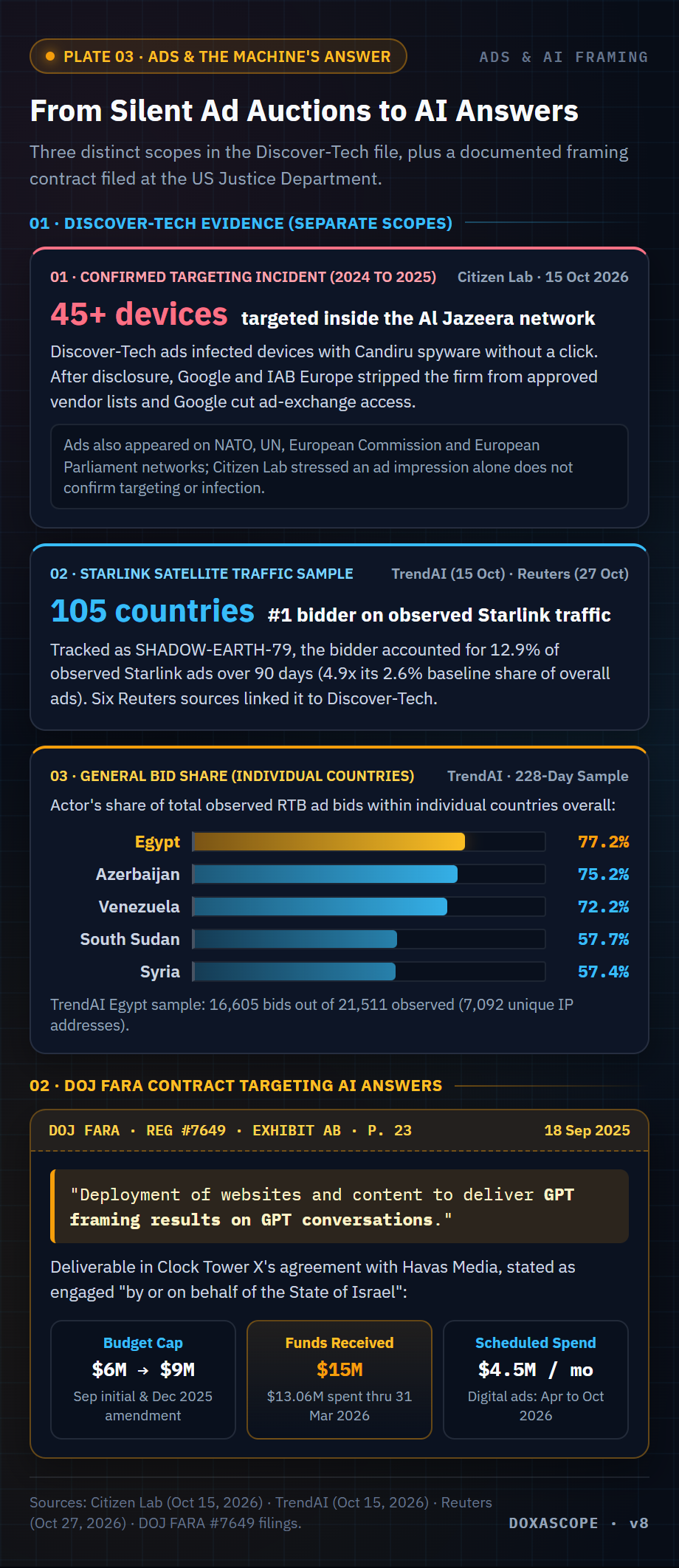
This layer begins with the ad auctions that opened this investigation. Inside the Al Jazeera network, the campaign targeted at least 45 devices in 2024 and 2025, and Citizen Lab proved that some were infected with spyware developed by Candiru, now known as Integrity Labs. Discover-Tech ads also appeared inside the networks of NATO, the United Nations, the European Commission and the European Parliament. There, the lab's evidence stopped at ad impressions. [15]
Discover-Tech had been listed since 2020 on vendor registries maintained by Google and IAB Europe. In October 2026, both removed the company after Citizen Lab shared its findings, and Google suspended its access to ad exchanges. The report uncovered another link to the spyware industry: among Discover-Tech's shareholders from 2020 to March 2026 was a company connected to Sara Hamou, who managed the corporate network behind Intellexa and Predator. [15]
TrendAI researchers monitored real-time ad auctions over 228 days across more than one million IP addresses. Over a 90-day test period on Starlink traffic, the actor linked by Reuters sources to Discover-Tech accounted for 12.9% of observed Starlink ads, 4.9 times its 2.6% baseline share of overall ads.
In the broader sample of observed ad auctions in Egypt, the report recorded 16,605 bids out of 21,511 (77.2%) for that actor, alongside high shares in Syria (57.4%) and South Sudan (57.7%). Researchers assessed that the actor was likely using ad auctions to track internet users and pinpoint their locations. [16]
From tracking the screen, the effort shifts to shaping the narrative itself, exposed in two independent investigations into cross-border influence operations:
- Operation
PRISONBREAKin Iran. In October 2025, Citizen Lab (with Clemson University) documented a network of more than 50 inauthentic accounts on X created in 2023 and heavily active from January 2025 onward, posting AI-generated videos urging Iranians to revolt. On June 23, 2025, its posting synchronized with Israel's bombing of Tehran's Evin prison: the lab recorded the network's first confirmed post about the strike at 11:52 a.m. Tehran time, and at 12:05 p.m. while strikes were ongoing, its oldest account posted an AI video later labeled "fabricated" by BBC Persian after deceiving news outlets that republished it. Citizen Lab concluded that the hypothesis most consistent with the evidence is that "an unidentified agency of the Israeli government, or a sub-contractor working under its close supervision, is directly conducting the operation." [22] BlackCorefrom France to Angola. On June 11, 2026, France's official anti-foreign-interference agency VIGINUM issued a 40-page technical report on an interference operation in France's March 15 and 22, 2026 municipal elections namedRokh Solis, involving defamation of La France Insoumise candidates and stoking polarization between rival ideological camps through coordinated sites and accounts. VIGINUM noted similarities with the methods of "an Israeli entity with no legal status" named BlackCore and linked those tactics to earlier campaigns in New York City's November 2025 municipal election, Scotland, Togo and Angola, while stating that the evidence was insufficient to conclusively identify the operator or sponsor of the French operation and noting that the campaign "achieved only limited visibility, despite numerous attempts at artificial amplification." Independently, on September 17, 2026, Citizen Lab exposed a training platform run by BlackCore for Angolan government staff to launch Meta and TikTok influence campaigns, while the firm claimed on its promotional site to control "several thousands of social media sockpuppet accounts" before erasing its websites and public accounts. [23]
China on the Front Line
On November 18, 2026, an X account whose owner says they live in China posted a prominent example of a narrative tying Israeli-rooted security and tech companies to Western outages and breaches: it compiled a list of those firms and incidents and asked Grok to name the companies' home country in one word, receiving the reply "Israel" in a post with more than 200,000 views when observed. [24] Months earlier, in January 2026, Reuters cited sources briefed on the matter reporting that Chinese authorities instructed domestic firms to stop using cybersecurity software from more than a dozen Israeli and US vendors, including Check Point, Palo Alto Networks, Wiz and CyberArk, fearing the software "could collect and transmit confidential information abroad." [24]
Public media friction between the two sides had already surfaced a year earlier: on September 15, 2025, Netanyahu told a visiting delegation of US lawmakers that actors led by Qatar and states such as China were mounting "an attempt to impose a new siege on Israel" and a "media siege, funded with enormous money," to which China's embassy replied that "China is shocked" by his remarks and called the accusation "baseless." [24]
Steering AI and Antisemitism Campaigns
The sharpest edge of this effort moves beyond social platforms to the machine you turn to for answers. In September 2025, Clock Tower X, owned by Brad Parscale, filed with the US Justice Department the text of its agreement with Havas Media in Germany. The filing states that Havas "has been engaged by or on behalf of the State of Israel" for a US campaign to combat antisemitism. [25]
The statement of work spells out an explicit deliverable: "Deployment of websites and content to deliver GPT framing results on GPT conversations," aiming to shape how AI models present the topic when questioned by users, alongside monthly search-engine campaigns on an AI platform called MarketBrew "to improve the visibility and ranking of relevant narratives." [25]
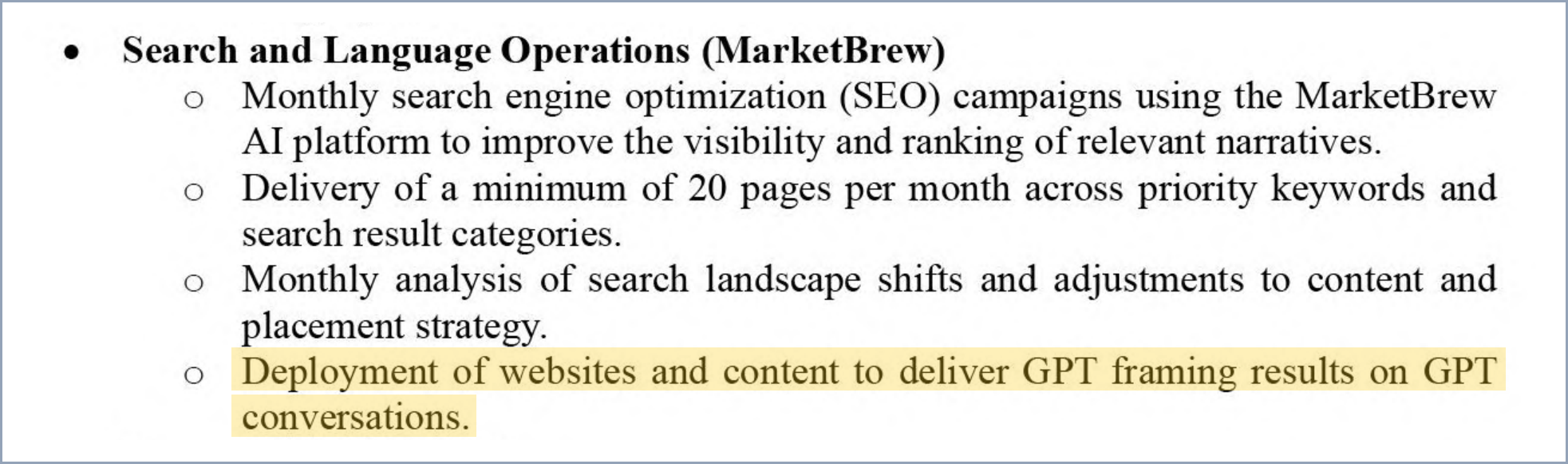
The budget started at $1.5 million per month for four months, before an amendment filed in December 2025 raised the pool to $9 million. In its May 2026 supplemental statement covering the six months ended March 31, 2026, the firm reported receiving $15 million and spending $13,061,802.50, then appended a $4.5 million monthly digital advertising schedule from April to October 2026, listing among campaign sites allyvia.org with articles on Hamas, Gaza and the US-Israel alliance. [25] Although the firm terminated its direct registration of the State of Israel as foreign principal on October 13, 2025 saying the filing "was in error," its December 2025 amendment retained the same engagement language, and the May 2026 statement described its work as supporting "Havas' engagement by the State of Israel." [25] The machine's answer had become a paid contractual target, "by or on behalf of the State of Israel."
5. In Their Own Words, and What the Documents Reveal
The strongest evidence in this investigation does not come from Israel's adversaries, but from the companies and officials themselves:
- Israel's Allot acknowledges in writing in its annual report that certain of its products "have been and may in the future be used by governmental or law enforcement customers in a manner that is, or that is perceived to be, incompatible with human rights." [26]
- Israel's Cellebrite disclosed, following an Amnesty International investigation into Serbian security services using its tools against journalists and activists, that it "found it appropriate to stop the use of our products by the relevant customers." [26]
- In a 2008 document, a senior NSA official calls the Israelis "extraordinarily good Sigint partners" who also "target us," adding: "the exchange is so robust, we sometimes share more than we intended." [2]
- Microsoft thanked The Guardian for reporting containing "information we could not access in light of our customer privacy commitments." [17]
- Netanyahu himself boasted to a visiting delegation of US state lawmakers on September 15, 2025, according to the Israeli Foreign Ministry's official transcript, asking whether they had cell phones and telling them: "You're holding a piece of Israel right there." [27]

What these documents expose is more dangerous than any secret, because the system works as designed. That is why the buyer's own question must change. When a ministry, bank or telecom company buys a defense system (or worse, a surveillance tool), asking "does it do the job?" is no longer enough. Before signing, buyers must audit the permissions table: who enters the network? Who holds the encryption keys? Where does the data go, and when is it deleted? Can the institution revoke permissions, migrate its data and shut the service down when it chooses to change vendors?
Open questions remain that public filings do not yet answer: which permissions were actually granted in each customer's contract? What is the state of Gaza's telecom network today? Which governments purchase tracking and hacking through ad auctions and signaling networks? And how far did AI model answers shift after the "framing" campaigns?
An ad can appear on your phone without your knowing who bought it or why they picked you. You can ask an AI model a question without knowing that someone has paid to try to shape its answer. In both cases, you see what reaches your screen. Who gets to see the decisions made before it got there, and who can hold the people who made them to account?
Who watches the world's watchers?
We prepared a companion report and an evidence register that brings together the cases, their sources and the strength of the evidence for each. We may publish them separately.
Read also:
Explanatory plates
Companion tool
Sources
[1] EFF archive; WIRED: Room 641A and Narus STA 6400; WIRED: Narus and Egypt (2011).
[2] The Guardian: NSA collecting phone records of millions of Verizon customers daily (June 6, 2013); The Guardian: NSA Prism program taps in to user data of Apple, Google and others (June 6, 2013); The Guardian: NSA shares raw intelligence including Americans' data with Israel (September 11, 2013); Memorandum of Understanding text published by The Guardian.
[3] Citizen Lab: Pegasus vs. Predator (December 2021); Citizen Lab: Ahmed Eltantawy (September 2023); US Treasury: Intellexa sanctions (March 5, 2024); NSO and Candiru Entity List (86 FR 60759); Meta: surveillance-for-hire (December 2021); Norwegian Council on Ethics recommendation (PDF); Norges Bank exclusion decision; Cellebrite FY2025 Form 20-F (DECA).
[4] Citizen Lab: Espionage Against the European Parliament: Stelios Kouloglou (July 3, 2026).
[5] Citizen Lab: Pegasus Spyware Infection of Serbian Pro-Democracy Student Activist (September 2, 2026); Citizen Lab: Targeting Democracy: Vladan Đokić & Serbia (October 19, 2026).
[7] US District Court for the Northern District of California Final Judgment: WhatsApp v. NSO (Doc. 810, November 12, 2025); US Ninth Circuit Court of Appeals: NSO opening brief via Knight Institute (February 11, 2026); Courthouse News Service: Israeli spyware company blocked from WhatsApp (October 17, 2025).
[8] Alphabet Q3 10-Q (Note 8: Wiz); Palo Alto Networks FY26 10-K (Note 8: CyberArk); ServiceNow Q3 10-Q (Note 5: Armis); Visa FY26 10-K (Note 2: BioCatch); CyberArk FY2024 Form 20-F (R&D staff).
[9] Check Point FY2025 Form 20-F; ETH Zurich study on Unit 8200; CTech: Israel Innovation Authority 2025 report; Israel Innovation Authority and Dealroom: Israeli Deep Tech Report 2025 (PDF); Wiz: Assaf Rappaport bio; Index Ventures: founders of Adallom and Wiz.
[10] WildFire privacy datasheet (October 2026); Support data processing locations.
[11] Wiz roles on Google Cloud (useToDecrypt / getData / sourceCodeGet); CyberArk service definition on UK G-Cloud 15; Idira/CyberArk privacy FAQs (Annex 1 & 2); REDLattice SEC Form 8-K Ex. 99.3 (Notes 3 & 16); Citizen Lab: Graphite.
[12] SMEX: Invasive Israeli-founded bloatware is harvesting data from Samsung users in WANA (February 13, 2025); SMEX: Open letter to Samsung (May 5, 2025); SamMobile (November 2025, with Samsung reply); Android Authority (November 17, 2025).
[13] World Bank: Telecommunication Sector Note in the Palestinian Territories (February 2016); ISOC Palestine at IETF 118 (November 6, 2023); Access Now: How Israel is shutting down the internet in Gaza (November 10, 2023).
[14] Human Rights Watch: Gaza Communications Blackout Imminent Due to Fuel Shortage (November 15, 2023); Access Now: Paltel Group response to HRW and Access Now.
[15] Citizen Lab: How Discover-Tech turned targeted ads into a pipeline for spyware (October 15, 2026).
[16] TrendAI Research: Invasive Ads: SHADOW-EARTH-79 & Starlink; Reuters via iTnews (October 27, 2026); Gizmodo; Tom's Hardware.
[17] The Guardian investigation, November 16, 2026; The Guardian: 'A million calls an hour' (August 6, 2025); The Guardian: Microsoft blocks Israel's use of its technology (September 25, 2025); Microsoft: Update on ongoing Microsoft review (September 25, 2025); AWS Economic Impact Study: Israel (2023); AP via Fortune: Israel's use of Microsoft and OpenAI (February 2025); The Guardian: Lavender (April 3, 2024).
[18] The New York Times: Israel Deploys Expansive Facial Recognition Program in Gaza (March 27, 2024); AOAV: Corsight & Essex Police / Digital Barriers (July 7, 2025); AFSC Investigate: Corsight AI (summary of March 2024 NYT report).
[19] United Nations: Lebanon complaint of March 22, 2024 (A/78/823 - S/2024/256); United Nations: Lebanon's letters dated July 24, 2024 (A/78/975 - S/2024/566); Los Angeles Times: Israel blamed for GPS spoofing (July 9, 2024); L'Orient Today: Lebanon UN complaint on GPS interference (August 1, 2024); The961: Lebanon UN complaint (March 2024).
[20] AP via PBS NewsHour: Iran built a vast camera network to control dissent. Israel used it to track targets (March 23, 2026); Financial Times: Inside the plan to kill Ali Khamenei (March 2026).
[21] Reuters: How Israel's bulky pager fooled Hezbollah (October 16, 2024); AP via PBS: Survivors of Israel's pager attack (August 6, 2025); AP via PBS: Netanyahu addresses 2026 UN General Assembly (September 24, 2026).
[23] SGDSN / VIGINUM: Technical Report Rokh Solis / BlackCore (PDF, 40 pages, June 2026); SGDSN publication page; Citizen Lab: BlackCore's Influence Operations for Hire (September 17, 2026).
[24] The post on X (November 18, 2026); Reuters via The Star: Beijing tells Chinese firms to stop using US and Israeli cybersecurity software (January 2026); Ynet: Netanyahu and China (September 15, 2025); China Daily: Chinese embassy reply (September 19, 2025).
[25] FARA 7649: agreement and statement of work (September 18, 2025); FARA 7649: December 2025 amendment; FARA 7649: supplemental statement (May 18, 2026); FARA 7649: advertising schedule (June 2026).
[26] Allot FY2025 Form 20-F (Items 3D & 4B); Cellebrite FY2025 Form 20-F.
[27] Israeli Ministry of Foreign Affairs (gov.il): Official transcript of PM Netanyahu's remarks at the "Fifty States - One Israel" event (September 15, 2025); TRT World: Netanyahu to US lawmakers: 'Your cell phones and medicines carry Israel's mark' (September 16, 2025).