The Same Seed
2026-08-17 · A.F. Sadek
The Same Seed
How was ordinary matter built from the same basic stock?
Water, rock, air, stars, cells, and our bodies look like different things. Water flows. Rock resists the hand. Air cannot be held. Stars burn. Cells live.
Ordinary matter is built from the same basic stock. What changes is not a different kind of raw substance, but the number of particles, the way they are arranged, the relations among them, and the form of energy the system carries.
That is the idea: a small inventory of the same parts, in different configurations.
Test it on something close: a cup of water. Take the cup apart, layer by layer, from the hand to the molecule, to the atom, to what sits inside the nucleus, to the histories of hydrogen and oxygen. At each layer the question is not how we might imagine it. It is: how did we actually come to know?
The cup is still on the table. What changes is how deeply we can see into it.
The Cup of Water
Look at the surface. It is continuous, cold, and almost featureless. It seems like one simple substance with one behavior: it wets a finger, bends light, and takes the shape of the cup that holds it.
The cup is a vast gathering of water molecules, (\mathrm{H_2O}). Each molecule is two hydrogen atoms and one oxygen atom. Inside the molecule, oxygen is bound to each hydrogen by a covalent bond that shares electrons. Oxygen pulls those electrons more strongly, so charge is not spread evenly: the oxygen side is partly negative, the hydrogen sides partly positive. Hydrogen bonds then form between molecules, and they do much of the work of holding water together as a liquid. The bonds inside a molecule are not the same as the attraction between molecules, though both are electromagnetic in origin.
We can take this molecule apart and put it back together. Electricity splits water into hydrogen and oxygen gas. The two gases can be combined again and become water. That is the first answer to “how did we know?”: we can separate these elements and rejoin them in a laboratory.
Then light. Each element has a spectral fingerprint. It absorbs and emits light at specific energies that do not match those of any other element. If we find hydrogen’s fingerprint in a flame, in sunlight, or in the remains of a distant dead star, we can say it is there.
We often picture the atom as a tiny solar system: a positive nucleus at the center, electrons circling it like planets. The picture helps at first, and misleads if taken literally. Electrons do not travel on fixed circular tracks. They occupy quantum states and orbitals: distributions of probability, not drawn paths. The electron is a light, charged particle. The way its energy is distributed shapes the molecule and its chemistry.
The cup has now come apart into two elements, and the elements into nuclei and electrons.
The question is no longer: what third substance is hidden in the water?
It is: why are there two different elements at all, rather than one cosmic material?
The Periodic Table
Hydrogen and oxygen are not two different kinds of primordial stuff. Both are made from the same parts.
The difference is one number: the count of protons in the nucleus. One proton is hydrogen. Six is carbon. Eight is oxygen. Seventy-nine is gold. The periodic table orders elements by proton number and groups those with similar behavior.
The likeness comes from the arrangement of electrons in the outer shells. Sodium and potassium act in similar ways. So do fluorine and chlorine. Carbon, with six protons, can form long chains from which living things are built. Its electrons let it bond easily and repeatedly with hydrogen, oxygen, and nitrogen.
Neutrons and Isotopes
Neutrons add mass and do not change the element’s identity. That is what isotopes are. Some atoms lose electrons and become ions. The schoolroom rule that every atom contains a proton, a neutron, and an electron is not absolute. Ordinary hydrogen, for example, has no neutron at all.
So the table has rows and columns. The variety around us, water, salt, iron, air, sugar, gold, does not mean ordinary matter needs dozens of different raw substances. It means that changing one number opens a new chemical behavior.
How Did We Know?
This was not a guess. Elements confirm their identity in three independent ways:
- Chemistry: the same reactions, repeated.
- Light: spectral fingerprints that do not coincide from one element to another.
- Nuclear physics: measurements that count the positive charge and the particles inside the nucleus.
But protons and neutrons are not the last stop.
If an element’s identity depends on the number of protons in the nucleus, what is a proton made of?
Beneath the Nucleus
Protons and neutrons are not solid elementary beads. They are composite.
The best map we have of this depth is the Standard Model. It is not a theory of everything. Gravity lies outside it, and so do dark matter and dark energy. It is a well-tested account of three interactions, electromagnetic, strong, and weak, and of the particles that take part in them.
Matter particles in the model come in two families: quarks and leptons. Each family has six members in three generations. The first generation is the lightest and the most stable. Heavier generations appear in violent collisions and then decay quickly.
The stable ordinary matter around us, including water, rock, the body, and most of the luminous matter in stars, is built mainly from three particles of that first generation:
- the up quark
- the down quark
- the electron
A proton is two up quarks and one down quark. A neutron is two down quarks and one up quark.
Forces Inside the Cup
- The strong force, through gluons, binds quarks inside the proton and the neutron. At a larger scale, the residual effect of that interaction binds protons and neutrons inside the nucleus.
- The electromagnetic force, through photons, binds electrons to the nucleus, making the atom, then the molecule, then the liquid that takes the shape of the cup.
- The weak force is responsible for the decay of some nuclei and plays a part in the history of the elements.
- The Higgs field contributes to the masses of elementary particles. It does not, by itself, explain the mass of the proton, as we will see.
Ordinary matter does not rest on one magic particle that made everything. It rests on a small shared stock. The variety is in the assembly, not in a difference of basic ingredients.
Fields Are Deeper Than Little Balls
Picturing particles as hard little spheres is not accurate. In the present description, a particle is a quantized excitation of a quantum field. An electron is an excitation of the electron field. Light is an excitation of the electromagnetic field. A quark is not a ball inside the proton. It is a pattern in its field, and it shows up as a particle when we measure it.
How Did We Confirm What Cannot Be Seen?
No one photographs a quark the way one photographs a pebble. What appears in colliders is the debris of a collision: angles, energies, momentum. By repeating the experiments and counting the results, we learned that a proton does not behave like a solid bead. It contains very small, pointlike scattering centers. The evidence is statistics and repetition, not a direct look with the eye.
We have reached the floor of the present description of ordinary matter in the cup. If we stop at a list of particles, something is still missing. Mass itself cannot be understood without energy.
Energy Is Not Another Ingredient
It is a property of a physical system: its capacity to produce change. It is a quantity we can measure, and one that is conserved in the right descriptions of closed systems. It does not enter the scene as an independent material. It only changes its form: motion, heat, chemistry, radiation, or nuclear energy.
Mass and Energy
(E = mc^2) is a relation between two quantities we measure. Because the square of the speed of light is a huge number, a small loss of mass corresponds to a large amount of energy on human scales.
Two examples:
The mass of the proton. Add the masses of the three quarks as if they were quiet beads, and you get only a small fraction of the proton’s mass. Most of the rest is the energy of the strong-interaction system: the motion of the quarks and gluons, and the energy stored in fields confined to a tiny space. Mass here is a property of a bound system, not the sum of idle parts.
Fusion in the Sun. When lighter nuclei fuse into a heavier, more tightly bound nucleus, the mass of the product is a little less than the sum of what went in. The difference is released as energy. That is what happens in the Sun. The light that reaches the cup is not proof that matter has become some other essence. It is evidence that a nuclear system became more tightly bound and the difference was released.
We do not see energy itself. We infer it from its effects: a photon when an electron moves between two states, heat as the microscopic motion of particles, a mass defect that appears as light in a stellar core. In the cup, most of the mass sits in the nuclei, and most of the mass of those protons and neutrons comes from the dynamics of the strong interaction inside them. The energy of chemical bonds between atoms and molecules is much smaller. When a bound system forms, its mass falls a little, by the released binding energy divided by (c^2). The cup is not filled with a substance called energy.
Now the two elements in the cup can be read as traces of two different histories.
Two Histories Inside the Water
The hydrogen and oxygen in a water molecule were not born together. Each came from a different time and place.
Hydrogen
In the first minutes, during Big Bang nucleosynthesis, protons and neutrons collided and made nuclei of hydrogen and helium, with a faint trace of lithium and beryllium. After about five minutes the universe had expanded and cooled enough that new element-making stopped there. The matter was nuclei, not neutral atoms.
After about 380,000 years, the universe was cool enough for nuclei to capture electrons and become neutral atoms. The fog cleared, and the light we measure today as the cosmic microwave background was released. Most of the hydrogen in the cup belongs to a cosmic stock formed in that early epoch. Its existence as atoms able to bond is a later layer.
Oxygen
Mid-sized stars burn hydrogen into helium. If the core is hot enough, three helium nuclei fuse into carbon, and carbon may capture another helium and become oxygen. Later those stars shed some of their matter in winds and planetary nebulae, and leave a white dwarf.
Heavier stars go farther down a burning chain: carbon, neon, oxygen, silicon, as far as iron. Then they explode or throw off their layers. The oxygen we breathe, and the oxygen that holds the hydrogen in the cup, left those kitchens when the stars died, entered new clouds, then planets, then oceans.
Beyond Iron
Many of the elements heavier than iron, gold among them, form mainly by neutron capture in different settings. Slow capture happens, for example, in late stages of low- and intermediate-mass stars, including asymptotic giant branch stars. Rapid capture needs enormous neutron fluxes, as in neutron-star mergers and some explosive events. Other channels may contribute; their relative contributions are still being studied. The table was not filled by one furnace.
How Did We Know These Two Histories?
Independent records meet:
- The abundances of hydrogen and helium in the early universe match the calculation of primordial nucleosynthesis.
- The cosmic microwave background records the stage when nuclei became neutral atoms.
- Stellar spectra show carbon, oxygen, and iron where they should appear if stars are factories of elements.
- Meteorites, remnants of explosions, and observed mergers constrain where the heavier elements can form.
The order is the same: the lightest first, then what stars cook, then what is finished only in death or collision. The ages meet in a single sip.
How We See the Universe
Light is our main messenger to what the hand cannot reach. A telescope does more than enlarge a distant disk. Across the electromagnetic spectrum, a photon carries specific information:
- lines reveal composition
- the shape and peak of the radiation reveal temperature
- shifts in the lines reveal motion
- the size of that shift, combined with other methods, helps us estimate distance
Two Kinds of Shift
When a star moves toward us or away from us through space, its spectrum shifts as the pitch of a train whistle shifts. That is the Doppler effect: motion through space.
Most of the light from distant galaxies is redshifted because space itself stretched while the light was on the way. The two galaxies may be at rest in their local surroundings, and the wave still lengthens. Cosmological redshift is not an ordinary Doppler shift. Rising bread moves raisins apart without the raisins running across the table.
A Web, Not a Uniform Fill
Galaxies are not scattered evenly. They gather in clusters and filaments, with wide voids between them. Hot gas is seen in X-rays. Fainter gas appears when it crosses more distant light, the light of a quasar, for example, and leaves absorption lines. The cosmic microwave background is the oldest light we have: a trace of the universe from the time atoms became neutral.
Ordinary matter itself is not all locked in visible stars and planets. Much of it is spread through filaments, halos, and the space between galaxies. The cup is a rare density in a world that is mostly empty.
How Did We Confirm This Map?
Independent maps converge: the distribution of galaxies, hot gas, absorption against background light, ripples in the cosmic microwave background, and the gravitational effects on light and matter. Agreement does not mean we have seen everything. It means the large-scale structure is not the drawing of one telescope.
And all of this is a map of what interacts with light, or can be inferred from that interaction. It is not the whole budget of the universe.
The Five-Percent Limit
In the standard cosmological model today, ordinary matter, whose mass sits mostly in protons and neutrons, with electrons completing the atoms, the matter we used to build the cup, the table, and the stars, accounts for about five percent of the present mass-energy density.
Dark matter is a name for the extra gravitational effect produced by something that does not interact with light as ordinary matter does. Its particle identity is unknown.
Dark energy is the name given to the component used in the standard model to account for the accelerated expansion of the universe. A deeper theory might eventually replace that description. It is not a fluid we have captured, and not an ordinary force like the one that binds a water molecule.
Radiation is real as well, but today it is only a small part of the budget.
The fraction is not measured by placing the universe on a scale. It is inferred by fitting one model to independent observations, above all the cosmic microwave background together with measurements of expansion and large-scale structure.
The phrase “ordinary matter” at the start of this essay was not a verbal hedge. It marked a boundary. The unity we followed belongs to what we can take apart and illuminate. It does not claim to be a recipe for the whole cosmos. The fuller account of dark matter and dark energy is in Dark Things.
Back to the Cup
The cup is on the table as it was.
Most of the hydrogen in its molecule comes from a stock formed before the first star. The oxygen was made in earlier generations of stars and spread after they died. The electrons and quarks belong to the same stock of ordinary matter. The bonds are electromagnetic. The mass is a property of an organized system, not an extra substance in the glass.
The cup has not changed. What has changed is the depth of our view.
Water is still water. It is no longer a stranger to the star, or to the hand that holds it. The hand that holds the cup carries, in its bones, the history of life. The water in the cup carries, in its atoms, the history of stars. Both are made from the same seed. Both have returned to ask where they came from.
Selected Sources
Water and the Periodic Table
The Standard Model and Nuclear Structure
- CERN, The Standard Model.
- U.S. Department of Energy, DOE Explains…The Strong Force.
- CERN Courier, The proton laid bare.
- Yang et al., Proton Mass Decomposition from the QCD Energy Momentum Tensor, Physical Review Letters (2018).
- Dürr et al., Ab initio determination of light hadron masses, Science (2008).
Light, Spectra, and Redshift
- NASA, Spectroscopy 101 – Beyond Temperature and Composition.
- NASA Hubble, Spectroscopy.
- NASA Hubble, Cosmological Redshift.
- ESA, What is ‘red shift’?.
The Early Universe and the Elements
- NASA, Cosmic History.
- NASA Webb, Early Universe.
- Chandra X-ray Observatory, Stellar Evolution.
- Johnson, J. A., Populating the periodic table: Nucleosynthesis of the elements, Science (2019).
- Domínguez et al., s-process nucleosynthesis in low-mass AGB stars by the ¹³C(α,n)¹⁶O neutron source, The European Physical Journal A (2026).
The Cosmological Budget
- ESA, Planck's new cosmic recipe.
- Planck Collaboration, Planck 2018 results. VI. Cosmological parameters, Astronomy & Astrophysics 641, A6 (2020).
- Nature, Missing matter found in the cosmic web.
Image
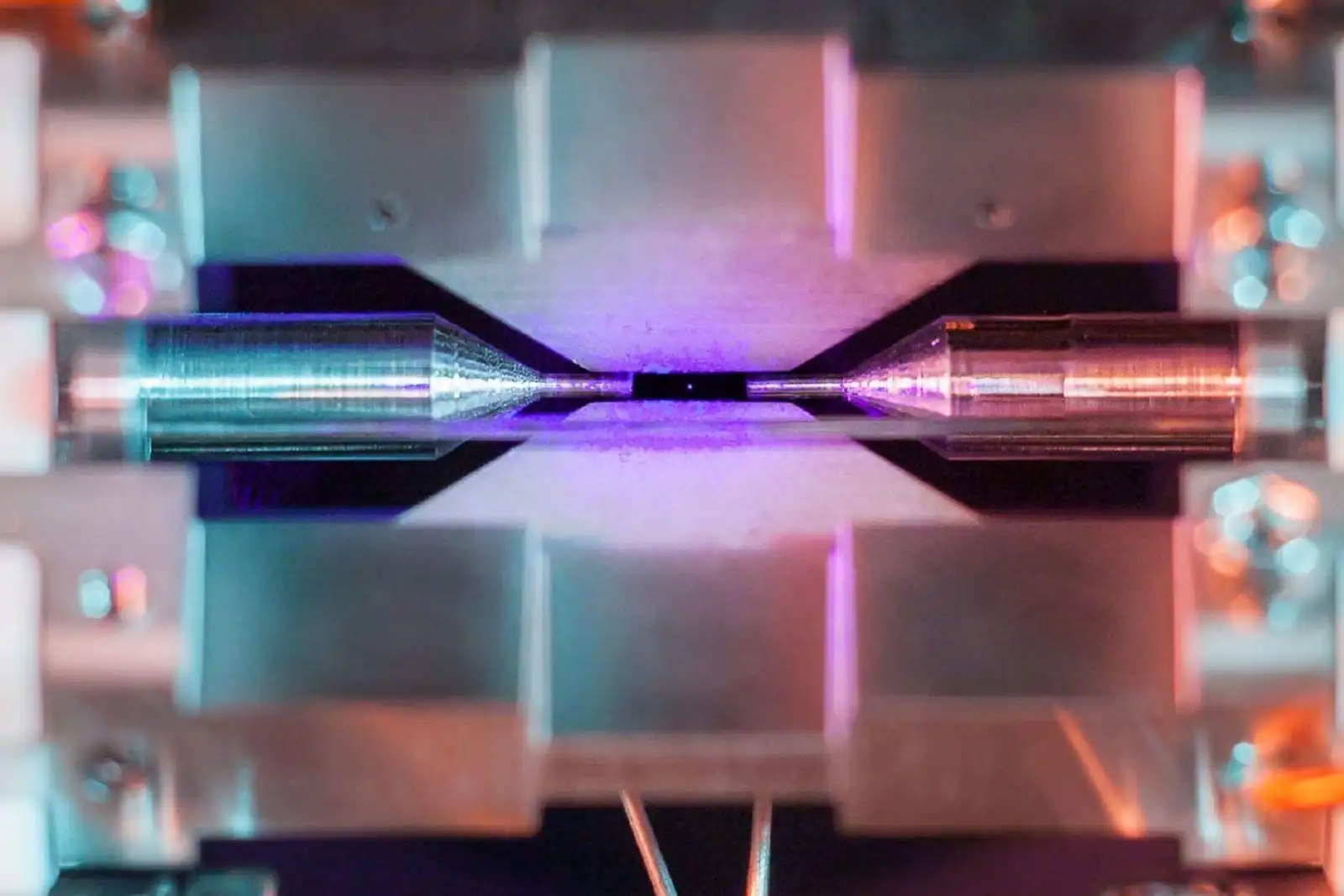
Single Atom in an Ion Trap: the bright point at the center of the image is light re-emitted by a single positively charged strontium ion illuminated by a laser and held nearly motionless between the electrodes by electric fields.
Image credit: David Nadlinger / University of Oxford / EPSRC.