Dark Things
2026-06-25 · A.F. Sadek
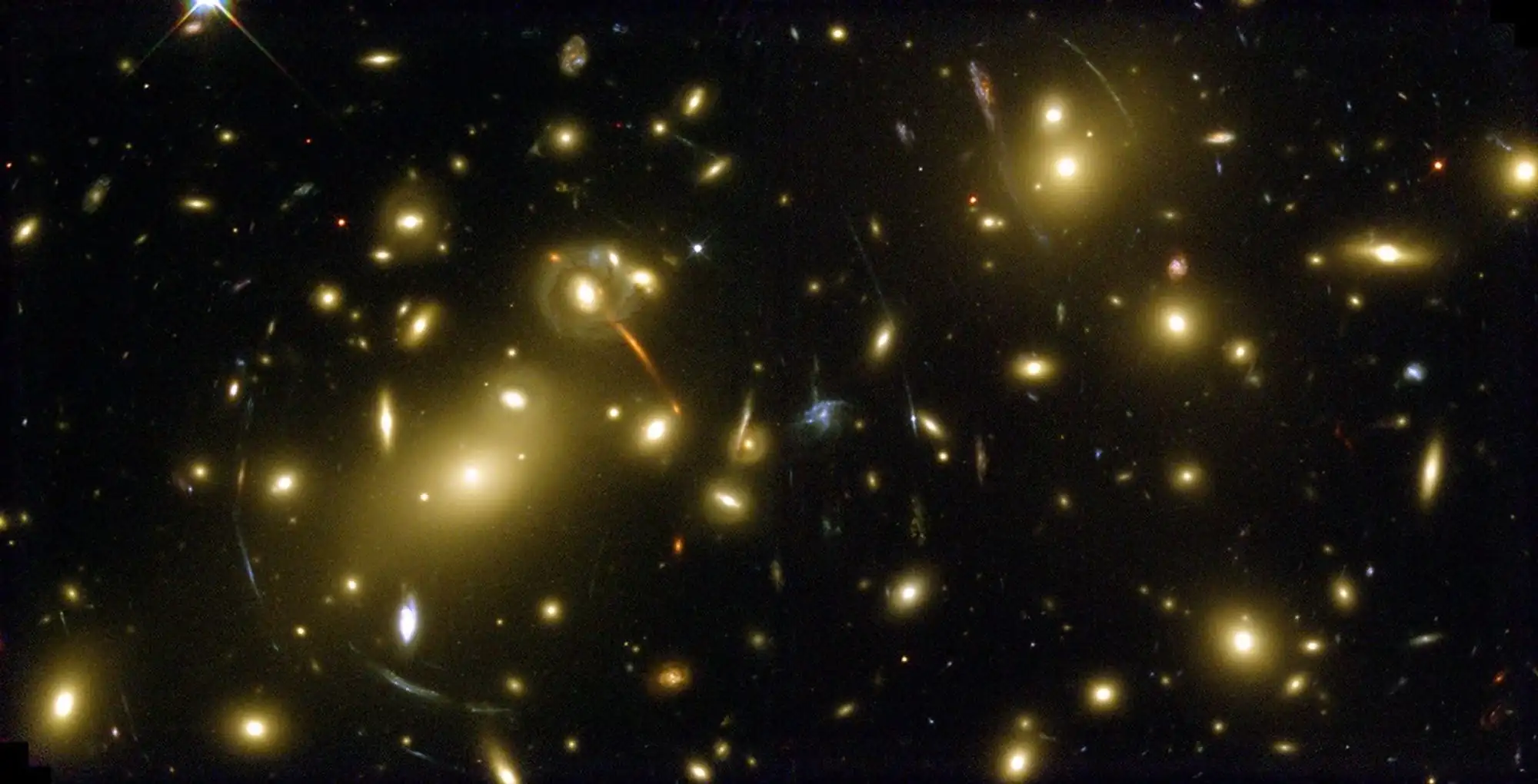
I like skepticism around dark things.
It protects science from easy language. A word like "dark" immediately invites myth: a hidden thing, a mysterious force, a door behind the world. But its scientific use is much colder than that. Dark does not mean black, or evil, or spiritual. It means: there is an effect, and we do not yet see what carries it.
So the useful question is not: did scientists invent dark matter and dark energy to save their equations?
The sharper question is: does the missing piece appear in one place only, or does the universe leave the same shadow on several different walls?
Dark Matter: A Shadow With Weight
If galaxy rotation were the only evidence for dark matter, the doubt would stay wider. It is always fair to ask whether gravity itself needs adjustment on enormous scales. That question is legitimate, and whole scientific schools have explored it.
But the strength of dark matter does not come from one galaxy. It comes from the same kind of effect appearing in places that do not resemble one another.
In the Bullet Cluster, two huge galaxy clusters collided. The hot gas, which contains most of the visible ordinary matter in those clusters, slowed down and gathered through friction. But the mass map reconstructed through gravitational lensing did not stay with the gas. Most of the mass appeared elsewhere, as if something heavy had passed through the collision with little resistance.
That does not tell us what dark matter is. It does make the idea of "mass that does not interact with light the way ordinary matter does" much stronger than a mathematical patch.
Then there is the cosmic microwave background. It is a trace from the universe when it was very young. Its tiny ripples carry information about the ingredients the universe needed in order to become what it became. Planck's results, for example, give a rough cosmic recipe: a small amount of ordinary matter, much more dark matter, and more dark energy than both. This measurement adds evidence from the early universe, a different time and scale than the rotation of nearby galaxies.
And then there is large-scale structure: the web of galaxies, filaments, and voids. Ordinary matter was initially coupled to radiation too strongly to clump freely. Dark matter, if the model is right, began forming gravitational wells earlier, and ordinary matter later fell into those wells. The universe built an invisible scaffold before hanging light on it.
Each line of evidence can be argued with. Their convergence is what gives the idea weight.
Dark Energy: A Name for a Fate, Not a Thing We Hold
Dark energy is stranger, and less like matter. It should not be imagined as a hidden gas filling space. It is closer to a temporary name for whatever appears to be making the expansion of the universe accelerate.
The name itself is an admission of incompleteness. We do not know what it is. We know that something in the observational accounting makes the universe behave differently than expected if gravity, ordinary matter, and dark matter alone set its fate.
The modern story began with measurements of distant supernovae: the universe is not only expanding, but appears to be expanding faster over time. Then came measurements of the cosmic microwave background and the geometry of the universe. If the universe is very close to flat on large scales, and matter alone does not reach the critical density, there is a missing entry in the budget.
This is why I dislike saying "dark energy is proven" without care. A better sentence is: the current standard model of cosmology needs something playing this role, and several independent observational lines support it, from supernovae to the cosmic microwave background to large-scale structure signals such as baryon acoustic oscillations.
That is enough to make the name serious, not comfortable.
What If Gravity Is Wrong?
This objection deserves respect. Maybe the problem is our understanding of gravity at cosmic scales. Science does not respect a model because it is famous. It respects a model because it survives many different tests.
Modified gravity models can sometimes explain part of the behavior, especially galaxy rotation. The harder test is asking them to explain the Bullet Cluster, the cosmic microwave background ripples, the growth of large-scale structure, and accelerated expansion with the same numbers, without quietly paying the cost somewhere else.
So I do not read dark matter and dark energy as finished final truths. I read them as the best current names for wide, repeated effects. Names for a disciplined absence.
Why This Matters Outside Physics
What interests me here is not darkness. It is the method of knowing.
Sometimes we do not know a thing by its face. We know it by its pressure. By the bending of light around it. By a gap in the budget. By a fate changing slowly because something unseen is working in the background.
This is not proof of Doxascope, and it should not be. The novel does not say that dark matter is the Silence, or that dark energy is one of its forces. This is an essay about science, not canon.
But the resonance is clear to me: some things enter awareness not as bodies, but as effects. We do not yet have their face, and still the world changes around them as if they are standing there.
In science, that is not enough to call them final truth.
It is enough to take their shadow seriously.
Sources
- NASA Science: Hubble and Chandra Composite of Galaxy Cluster 1E 0657-556
- ESA: Planck and the Cosmic Microwave Background
- ESA Science & Technology: Planck's New Cosmic Recipe
- NASA Science: WMAP Overview
- NASA Science: What Is Dark Energy?
- NASA SVS: Baryon Acoustic Oscillations
Hero image: gravitational lensing, Hubble/JWST. Public domain, courtesy NASA Science.