From Cell to Question
2026-08-04 · A.F. Sadek
From Cell to Question
In the previous essay, we tried to return to a point before the words “where” and “when” could carry meaning.
This time, we will move in another direction.
We will begin with a being sitting before a screen, reading the ages of rocks, decoding its own inheritance, and building a machine that can answer back. Then we will take that being back, layer by layer, to a time without writing, human language, humans, or animals, and perhaps to a time when life itself could not be seen with the naked eye.
The question this time is not: what came before the universe?
It is:
How did a being inside the universe become capable of asking the question at all?
Human beings can now look inside a single cell and see parts of the history that made them. We can compare our DNA with that of other organisms, recover genes from the bones of extinct humans, and determine the age of a rock formed billions of years before the first animal appeared.
Then we place that knowledge in books, computers, and networks, and build machines that process the language we invented.
But the machine is not a new stage in the biological evolution of the human body. Our hands did not turn into keyboards, and our brains did not biologically become data centers. The machine belongs to another path, one much faster than genetic change: knowledge moving from mind to mind, then leaving the body and remaining after its maker has died.
This journey has more than one record. Life left bones, shells, footprints, and burrows in rock. It left another history in genes. Humans left tools, images, buildings, and texts.
Each record is incomplete. Yet the strange thing is that records that did not know one another, produced by different means, return us to the same broad story.
The Scale of the Journey
The mind has difficulty feeling the difference between a million years and a billion years. Both seem unimaginably remote, even though a billion years is a thousand million years.
The dates below are not precise birthdays for organisms. A complete species does not appear on a single morning. They are approximate points that help us see the scale of the journey, arranged from the present into the past:
About 5,200 years ago: The earliest known writing systems appeared in Egypt and Mesopotamia.
About 12,000 years ago: Agriculture and settled life began to appear independently in more than one region. Homo sapiens had already existed for hundreds of thousands of years.
At least 300,000 years ago: Early members of our species, Homo sapiens, lived in Africa.
About 2.8 million years ago: The earliest currently known fossil attributed to the genus Homo dates to roughly this period, the branch to which our species belongs.
Six to eight million years ago: The lineages leading to humans and to chimpanzees and bonobos are estimated to have begun diverging from a common ancestor during this period.
66 million years ago: The extinction event that ended all non-avian dinosaurs took place. Birds survived, and mammals began diversifying into new ecological spaces.
About 150 million years ago: Early recognizable birds lived, after traits such as feathers had already appeared in dinosaur branches before modern flight was complete.
About 230 million years ago: The earliest known dinosaurs appeared. Around the same period, early forms on the path toward modern mammals lived as well.
More than 370 million years ago: Fish carried a mixture of fin and limb traits during the long transition from lobe-finned fish to limbed vertebrates.
About 540 million years ago: Animal diversity expanded in the seas during the Cambrian period, after multicellular organisms and earlier animals had already appeared.
At least 1.8 billion years ago: Eukaryotic cells were already present, the complex cells from which animals, plants, and fungi are built.
About 2.45 billion years ago: Free oxygen began accumulating visibly in the atmosphere during the transformation known as the Great Oxidation Event.
At least 3.4 to 3.5 billion years ago: Strong evidence exists for an ancient microbial world. Life may be older, but older evidence is harder to settle.
About 4.54 billion years ago: Earth formed.
If Earth’s age were a book of a thousand pages, Homo sapiens would appear only in the final lines of the final page. Writing would arrive almost at the last word.
The Being That Put Its Memory Outside Itself
You are reading symbols that were not born with humanity.
The capacity for language is much older than writing, but spoken words disappear moments after they leave the mouth. Before writing, memory lived inside living bodies. If the keepers of a skill died or the chain of transmission broke, a story, or a way to make a tool, prepare a remedy, or cross a desert, could vanish with them.
Humans did not invent learning from others. Many animals learn by observation and transmit local habits. But humans carried the capacity further: they transmitted longer instructions, stories about the absent, and plans for the future. Knowledge could accumulate instead of beginning again from zero.
Then writing appeared.
Known writing systems began to emerge in the late fourth millennium BCE. Cuneiform appeared in southern Mesopotamia shortly before 3200 BCE, and Egyptian hieroglyphic writing emerged at roughly the same time, around 3250–3200 BCE. Both systems began with administrative and accounting purposes before expanding into literature, law, and history. They did not begin with a grand narrative about the meaning of existence. They also began with bread, beer, and numbers. But they gave information a body outside its maker: a tablet that could survive the writer and reach someone the writer had never met.
From that point on, the process accelerated. Societies placed memory in clay, stone, papyrus, and paper, then in print, images, tapes, discs, and servers. Each layer stored more information, copied it more quickly, and carried it farther.
Genes transmitted the construction of the body. Culture transmitted ways of using the body and the world. Then digital machines arrived: a book could be copied millions of times, and an entire library could travel through a cable on the seafloor. Today, artificial-intelligence systems process the texts and images humans have accumulated and rearrange them.
But the machine does not stand outside human history.
It is the latest place where humanity has put its memory outside the body.
There Was a Complete Human Before Writing
It is easy to make another mistake: to treat the invention of writing as the beginning of the mind. But humans did not wait for the clay tablet to become human.
Our species, Homo sapiens, appeared in Africa at least 300,000 years ago. Archaeology records pigments, symbols, ornaments, and social exchange long before writing. Ochre, a mineral pigment, was used hundreds of thousands of years ago. Later evidence shows composite adhesives used to attach tools, along with engravings and implements that reveal planning, communication, and the storage of meaning before any known text. Words and grammatical rules do not fossilize, so we cannot name a particular day on which language was “invented.”
Humans spoke, made tools, buried their dead, and exchanged materials before cities and writing. Agriculture was not the beginning of cooperation either. Hunter-gatherers lived in groups, exchanged knowledge and materials, and adapted to changing environments.
Writing did not create the mind. It freed part of memory from the requirement that the mind carrying it remain alive. Knowledge was no longer limited by the speed of genetic change. A child could learn in a few years what humanity had taken thousands of years to discover, and useful information could spread without waiting for a new biological generation.
That is why recent human history looks so fast beside the history of life. The body changes slowly, across many generations. An idea can cross the world in a moment.
When We Were Not the Only Humans
We are the only surviving human species today, but that is a recent condition, not an ancient rule.
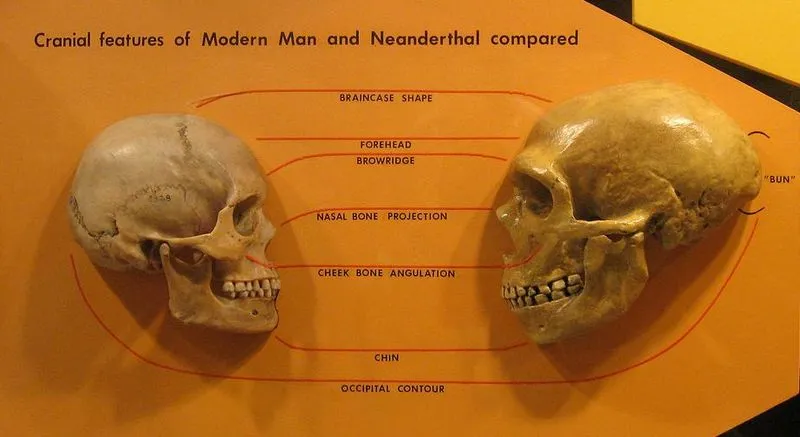
Until tens of thousands of years ago, different human groups lived on Earth: modern humans, Neanderthals, Denisovans, and others known from bones, or from fragments of DNA alone. These groups did not always remain separate. They met and interbred.
Many people today carry Neanderthal DNA, and some populations carry Denisovan inheritance. The remains of a girl were even found whose mother was Neanderthal and whose father was Denisovan. The human tree was not made of completely sealed branches. It was a network of groups that separated and met again.
Nor did this tree begin with something that looked like us and then move in a straight line toward the present. Our traits appeared at different times. Upright walking came millions of years before the large human brain; teeth, face, hand, pelvis, and foot changed in different sequences. Language, tools, walking, and the modern brain did not arrive as one package.
Science does not present a row with a monkey at one end and a human at the other. The better image is a tree with many branches. We did not descend from the apes living today; we and they descend from older common ancestors, and each branch then took its own path.
The human being does not stand above the tree or outside it.
We are a branch within it.
How Does a Complete Form Change?
The difference between a fish and a walking animal, or between a land mammal and a whale, can seem too large to be produced by small changes. But the image behind that objection is not what happened. A fish did not give birth to an amphibian all at once, a land mammal did not give birth to a complete whale, and an individual does not turn into another species.
What changes is the population, across many generations. Each offspring resembles its parents but is not an exact copy. Some differences are inherited and can help with survival or reproduction.
The population does not plan what it will become. The fish does not know that land exists in the future of its descendants, and the land animal does not want to become a whale. Each generation lives in its present. But differences accumulate, populations branch, and environments diverge until the difference between two branches becomes large.
The organisms along the way are not “failed half-fish” or “incomplete half-whales.” Each is a complete animal living in the environment it encountered.
The Fish That Was Not Trying to Leave
More than 370 million years ago, fish lived in rivers and shallow water. Some already had bones in their fins arranged in ways that anticipated the later organization of limbs.
One of the best-known fossils in this story is Tiktaalik. It was a fish, with scales, fins, and clear aquatic traits. But it also had a mobile neck, stronger ribs, and bones and joints inside its fin resembling the shoulder, elbow, and wrist. Its fins could support its body above the bottom.
Tiktaalik was not the first land animal, nor the one “missing link.” It was one of several forms that show changes between lobe-finned fish and limbed vertebrates. The foot did not appear after the fin disappeared; its beginnings were already inside the fin, then changed in shape and use.
In shallow water, it can help an animal to push against the bottom, raise its head, or move between pools. None of this requires a plan called “the conquest of land.” What began as better movement in water and along its edge later opened a new world.
The Land Animal That Returned to the Sea
The whale seems to tell the opposite story: a massive body living in water and resembling a fish, though it is not a fish.
Whales breathe air, nurse their young, maintain their body temperature, and carry in their front flippers bones that correspond to the bones of mammalian arms. Genetic and anatomical evidence places them among even-toed ungulates. Their closest living relatives are hippos, while older fossil relatives lie closer to the origin of whales than any living animal.
The fossil record preserves many stages of this return. Some early whales lived near rivers and could move on land. Later forms spent more time in water, and their limbs, spines, pelvises, tails, and hearing changed. Over millions of years, the hind limbs became smaller and lost their function, the front of the body became a swimming machine, and the nostrils moved toward the top of the head.
No land animal decided that the sea was better. But some populations lived near water, and bodies that swam better were more likely to succeed there. Eventually, the sea was no longer a place the lineage visited.
It became the world that built its body.
The Dinosaur That Still Flies
People often say that the dinosaurs went extinct. More precisely, most dinosaur branches went extinct. Birds are the surviving branch.
Fossils show that many traits we associate with birds appeared first in non-flying dinosaurs. Feathers were found in theropod dinosaurs, along with a fused collarbone and shared structures in the limbs and skeleton. Feathers also appeared before full flight, perhaps first serving insulation, display, or other functions.
This is a recurring rule in evolution: an organ does not always appear for the function it performs today. A structure may begin with insulation and later enter flight. Bones inside a fin may begin by supporting a body above the bottom and later become part of a walking limb.
Evolution does not work like an engineer who starts with a goal and builds the right tool. It works with what already exists, changing and reusing it. The bird at your window did not appear after the dinosaurs ended.
It is a small dinosaur whose branch survived.
Before the Brain We Know
All these bodies received information from the world and acted on it.
But when did consciousness begin?
We do not know.
A rock may preserve a skull, but it does not preserve what its owner felt. We can study brains, senses, traces of behavior, and learning, but we cannot extract subjective experience from a fossil. So we will not trace the “first feeling.” We will trace the structures and capacities that made more complex forms possible.
Even a single cell can respond to light, chemicals, or injury, but response alone is not evidence of conscious experience. As multicellular animals appeared, it became useful to coordinate different parts of the body. A signal received by a sensory cell had to reach, quickly, the cells that moved the body.
Distributed neural networks appeared, then clusters of cells, then centers better able to integrate sensation, memory, and movement. The brain did not appear all at once, and nervous systems did not evolve in one direction. An octopus has a nervous system organized differently from that of mammals, and birds perform complex tasks with brains unlike the human brain.
Humans were not the first organisms to move, learn, remember, or use tools. What distinguishes us is the unusual combination of older capacities: open-ended language, broad teaching, cooperation, the ability to preserve knowledge outside the body, and a cumulative culture that grows faster than genes.
When There Was No Animal
If we go farther back, the human disappears, then mammals, then birds and dinosaurs, then limbed animals, then fish. Eventually we reach a world with no animal at all.
Most of Earth’s history had no eye, mouth, or bone. Life was microscopic.
Earth has been suitable for life for more than four billion years, and strong evidence exists for a microbial world at least 3.4 billion years ago. Older claims remain debated because nonliving processes can imitate some signs of life, and ancient rocks have been altered by heat, change, and contamination.
These small organisms were not a preface waiting for animals to appear. They changed the planet.
Some lineages produced oxygen through photosynthesis, but oxygen did not immediately fill the atmosphere. Reactions with rock, iron, and other materials consumed it. It began to accumulate visibly during the Great Oxidation Event, roughly 2.5 to 2.3 billion years ago, in a long and complex transformation whose details remain under study.
For many ancient forms of life, oxygen was harmful. Other lineages used it to extract more energy.
The world we breathe was not a fixed background in which life appeared.
Life helped make it.
When One Being Became Part of Another
Every animal, plant, and fungus is made of complex cells called eukaryotic cells. Most of these cells contain mitochondria, structures essential to energy production.
But mitochondria did not begin as organs inside the cell. Genetic evidence indicates that they came from bacteria that were once independent, then entered a close relationship with a cell from another lineage. Over time, much of their genetic material moved into the nucleus. They lost the ability to live alone and became part of the new entity.
The details and order of eukaryotic-cell origins remain under study, but the symbiotic bacterial origin of mitochondria is well established.
This was one of life’s largest transformations. One organism did not simply split into two; two separate histories met and became one. Almost every cell in your body carries a trace of that ancient union.
When Cells Stayed Together
After that, bodies made of more than one cell appeared. Multicellularity did not arise only once; it evolved in different branches, including animals, plants, fungi, and some algae.
Gathering alone does not make a body. Many cells can live side by side while each remains an independent entity. The deeper transition begins when cells cooperate, exchange signals, specialize, and depend on one another: one cell moves, another digests, another carries signals, and another reproduces for the whole.
A new level of organization appeared. No longer did every cell perform every function. Cells became parts of a larger pattern that could succeed only if its parts continued to cooperate.
This is coherence in a directly biological sense: connection, organization, specialization, and mutual dependence. But the word should not become a mysterious force driving life toward complexity. Multicellularity was not an inevitable goal, and the cells did not know they were building a future animal.
Genetic comparisons suggest that the tools for cell adhesion, communication, and regulation had roots in the single-celled relatives of animals. They were not created from nothing; older tools were reorganized inside a new entity, and multicellularity evolved by different routes.
Some of these bodies gave rise to sponges, jellyfish, worms, mollusks, insects, and fish, and eventually to branches leading toward mammals, primates, and humans.
But no straight path was waiting for us.
There was a tree branching without a final plan.
What Should We Have Found?
Anyone can reject a story. But the material record is not tested by whether a story feels comfortable or shocking. It is tested by what we should find if the story were true.
Suppose modern animals, dinosaurs, humans, and ancient marine organisms all lived near the same time, then were buried in one global catastrophe, or emerged from one vessel and spread across the Earth.
We should then find human bones, dinosaurs, modern mammals, and trilobites mixed inside the same layers. We should not find a stable order of organisms. The rocks should look like the trace of one catastrophe, not a sequence of seas, rivers, deserts, forests, soils, and reefs that formed, were buried, and were followed by other environments.
But that is not what we find.
As we descend into older layers, groups disappear in a repeated order. Human traces disappear first, then modern mammals and birds. In older layers, early mammals and birds appear alongside non-avian dinosaurs. Then we reach layers that precede all these branches, eras without terrestrial vertebrates, and finally rocks containing no animals at all.
This order is one foundation of fossil succession. It was used to arrange strata before modern radiometric dating. And the record preserves more than bones: footprints, nests and eggs, burrows, reefs that grew in place, forests turned to coal, and surfaces exposed to air and erosion before being covered by water.
These traces do not tell the story of one pile buried in one day. They preserve worlds that lived above other worlds.
Radiometric clocks later allowed scientists to measure the ages of many rocks. They did not replace the order of the layers; they gave it numbers. When different isotopes and methods are used on suitable materials, their results can be compared and tested rather than relying on one clock.
Why Don’t We Find Every Intermediate Form?
The fossil record is not a complete film. Most organisms die and decay without becoming fossils. A fossil can later be destroyed by heat, pressure, or tectonic movement, or remain buried somewhere we have not excavated.
So gaps exist. But gaps do not mean that the record has no order.
We have thousands of forms that combine traits from different branches and appear in expected layers. And fossils are not the only evidence: bones, genes, and the distribution of animals across islands and continents produce records consistent with the separation of land and the migration of lineages.
No tree matches every other tree in every detail. Scientists disagree about the positions and dates of some branches. But independent records return to the same broad structure: organisms share ancestors, branch, change, and go extinct.
Evolution does not rest on one fossil that can be hidden, or on one investigator who could invent the whole story. It is the best explanation that brings together an enormous number of traces from different fields.
What About Giants, Dragons, and Forgotten Civilizations?
A legend may begin with something real: a large bone, a rare animal whose story changed between tellers, or a catastrophe mixed with religious or heroic imagination.
Science cannot prove that one person never saw an unfamiliar animal somewhere. But it can ask about the lineage. A large animal needs food and leaves waste, tracks, and bones. If it reproduces, there must be a population, not one individual without parents or offspring.
The larger, more widespread, and longer-lived the organism, the more traces it should leave. That is why saying that a dragon story began with a bone or a real animal is different from saying that a lineage of giant dragons lived beside humans and then disappeared from rocks, genes, and every environment.
The same applies to a very ancient industrial civilization. Buildings and machines may disappear, but a civilization that consumed energy, changed the climate, moved metals, and produced unusual materials should leave disturbances in sediments, chemistry, and isotopes. The kind of trace we should expect can be tested.
A gap in the record does not make every possible story equally strong.
Life That Was Not Trying to Reach Us
When we tell the story backward, it is easy to make humanity look like the goal toward which life had been working.
But life was not waiting for us. Bacteria lived for billions of years without humans. Dinosaurs lived and flourished for more than 150 million years without being a failed stage before our arrival. Organisms simpler in structure than our bodies live today, but they are not “behind.” They are successful descendants of lineages that persisted and changed.
Evolution does not necessarily produce more complex organisms. It produces organisms able to persist and reproduce under their conditions until those conditions change, a competitor appears, a catastrophe occurs, or the lineage ends.
We are not outside that rule. The human body is the result of a long history of change, chance, selection, and extinction. Civilization, writing, and machines are a newer layer that moved part of our evolution into another domain: accumulated knowledge.
The genome did not build the computer directly. It built a being that could learn, speak, cooperate, and make tools. That being made writing. Writing kept knowledge outside the brain. Knowledge accumulated until humans made a machine that could process its traces.
From Cell to Question
We began with a being looking at a screen and asking where it came from.
We returned to writing and language, then to a world inhabited by more than one human species, smaller mammals, animals that left the water and others that returned to it, and dinosaurs that carried feathers before their descendants flew.
Then bones and animals disappeared, and cells remained. We found that part of a complex cell had once been an independent organism, and that bodies appeared when cells connected, specialized, and depended on one another.
Then we reached a microbial world that changed the air and sea, before a lung existed to breathe the oxygen it had helped create.
We do not yet know how the first life appeared. Evolution explains what happens once there are systems that reproduce, inherit traits, vary, and face selection. It does not yet provide a final, agreed account of every step that turned nonliving chemistry into the first system capable of evolving.
This is an open question, but it does not erase what came after. Not knowing the first word a human ever spoke does not mean languages did not evolve. Not knowing the path to the first life does not leave the later history of life without a record.
We do not know this history from one story. We know it because rocks, fossils, genes, and artifacts, independent and incomplete records, repeatedly return to the same tree.
The being that read this tree is not separate from it. The bones of its hand carry the history of the fish that preceded the limb. Its cells carry the trace of a union that happened before animals. Its brain is built from older systems that linked sensation, movement, and memory.
Its words carry a shorter, faster history: knowledge that left the body, remained, accumulated, and eventually made a machine that could answer the question.
The journey began with a cell that knew nothing of the world.
After billions of years, part of life became capable of reading the rocks that preserved its path, and asking:
How did I get here?
Selected Sources
Geological Time and the Fossil Record
- International Commission on Stratigraphy , International Chronostratigraphic Chart.
- U.S. Geological Survey , The Age of the Earth.
- U.S. Geological Survey , Fossils, Rocks, and Time: Fossil Succession.
Writing and Early Humans
- British Museum , How to Write Cuneiform.
- British Museum , Egyptian Hieroglyphs: A Timeline to Decipherment.
- Smithsonian Human Origins Program , Our Species Arose at Least 300,000 Years Ago.
- Smithsonian Human Origins Program , The Oldest Fossil of Our Genus.
- Slon et al., The Genome of the Offspring of a Neanderthal Mother and a Denisovan Father, Nature (2018).
- Smithsonian Human Origins Program , Language and Symbols.
- Mngomezulu et al., Ochre Communities of Practice in Stone Age Eswatini, Nature Communications (2024).
- Wojcieszak & Wadley, A Raman Micro-spectroscopy Study of 77,000 to 71,000 Year Old Ochre Processing Tools from Sibudu, Heritage Science (2019).
Major Transitions Between Life Forms
- Daeschler, Shubin & Jenkins, A Devonian Tetrapod-like Fish and the Evolution of the Tetrapod Body Plan, Nature (2006).
- Shubin, Daeschler & Jenkins, The Pectoral Fin of Tiktaalik roseae and the Origin of the Tetrapod Limb, Nature (2006).
- Thewissen et al., Skeletons of Terrestrial Cetaceans and the Relationship of Whales to Artiodactyls, Nature (2001).
- Thewissen et al., Whales Originated from Aquatic Artiodactyls in the Eocene Epoch of India, Nature (2007).
- Zhou, Barrett & Hilton, An Exceptionally Preserved Lower Cretaceous Ecosystem, Nature (2003).
- Padian, 25th Anniversary of the First Known Feathered Dinosaurs, Nature (2023).
Early Life and Complex Cells
- Javaux, Challenges in Evidencing the Earliest Traces of Life, Nature (2019).
- Betts et al., Integrated Genomic and Fossil Evidence Illuminates Life’s Early Evolution and Eukaryote Origin, Nature Ecology & Evolution (2018).
- Crockford et al., Revisiting the Greatness of Earth’s Great Oxidation, Communications Earth & Environment (2026).
- Eme et al., Archaea and the Origin of Eukaryotes, Nature Reviews Microbiology (2017).
- Sebé-Pedrós, Degnan & Ruiz-Trillo, The Origin of Metazoa: A Unicellular Perspective, Nature Reviews Genetics (2017).
- Sogabe et al., Pluripotency and the Origin of Animal Multicellularity, Nature (2019).
- Wolpert & Szathmáry, Multicellularity: Evolution and the Egg, Nature (2002).
Testing Claims About Earlier Civilizations
- Schmidt & Frank, The Silurian Hypothesis: Would It Be Possible to Detect an Industrial Civilization in the Geological Record?, International Journal of Astrobiology (2019).
Image
- Side-by-side comparison of Neanderthal and modern human skulls, Cleveland Museum of Natural History. Image credit: Creative Commons | hairymuseummatt.