Before There Was a Before
2026-08-03 · A.F. Sadek
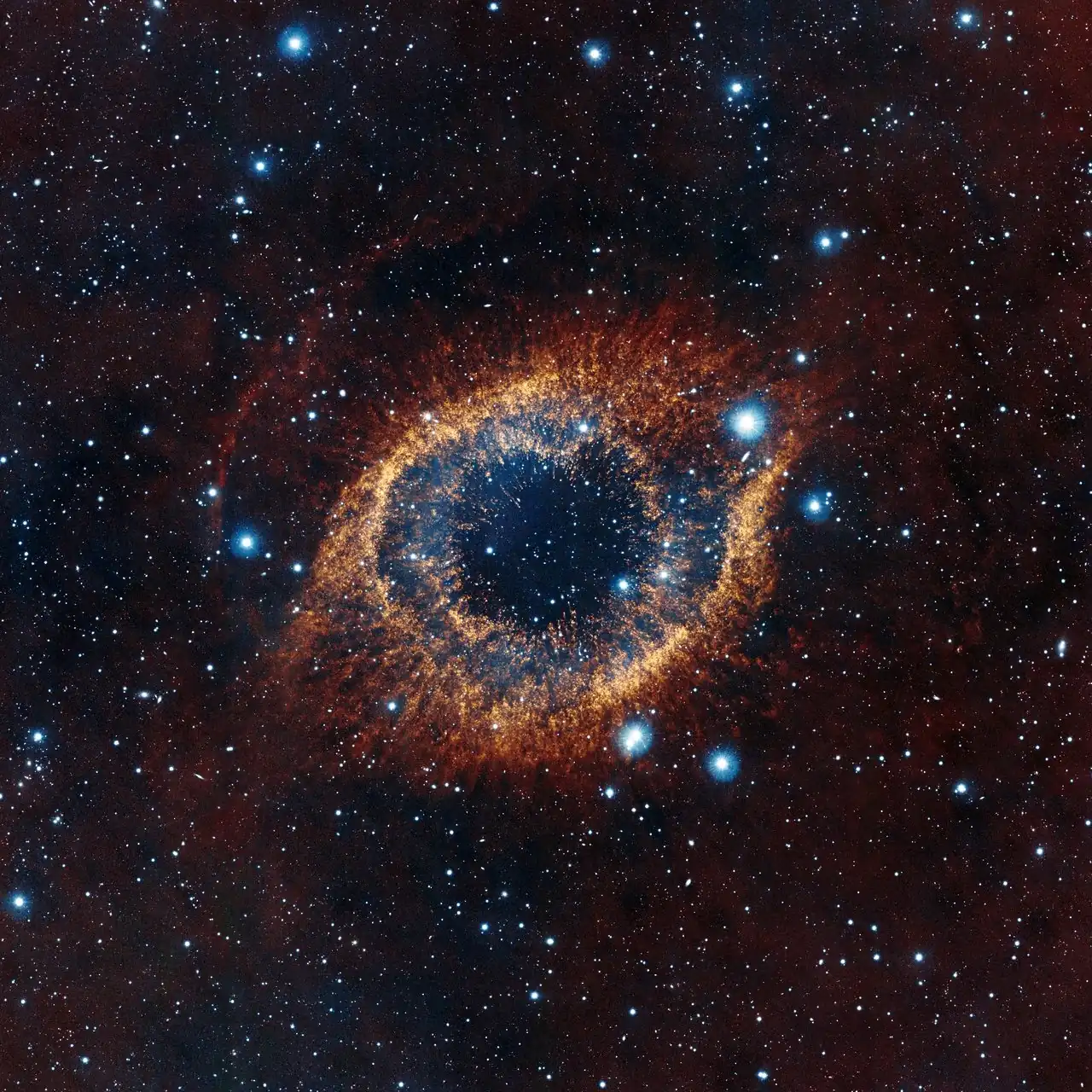
“In the beginning, there was no beginning.”
This is the first sentence in the opening of The Next Place, a novel set in the Doxascope universe.
Outside the novel, however, the question remains: what was there before the beginning of the universe we know?
I do not think what preceded spacetime was nothing. Nor do I think it was another place.
I think that whenever we try to imagine it, we place it, without noticing, inside a box and a clock.
Where was the universe before space existed?
And when was that, before time existed?
The questions sound innocent. But the first smuggles in a spatial container, assuming that the universe had a “where” in which it could stand. The second smuggles in a clock suspended outside the universe, ticking before time began. The mind cannot easily imagine the absence of a stage. So it replaces one stage with another, then calls the replacement a quantum vacuum, a mathematical space, a cosmic mind, or heaven.
This does not make the question foolish. It means that the question may carry inside it the very tools it claims to have removed.
In this essay I distinguish between two layers. The first is critical and grounded in physics: our everyday concepts of “before” and “where” may not extend to the origin of spacetime. The second is philosophical and belongs to my own position: the deeper candidate is not something inside a region, but a structural order that does not presuppose space and from which its geometry might take shape. I will try to keep the boundary between these layers visible.
The Question That Smuggles In Its Answer
“Before” is a temporal order. It assumes two moments, one earlier than the other. “Where” is a spatial location; it assumes a region and something situated within it. If time itself is one of the things we are trying to explain, then asking what was “before” it has no literal meaning. If space itself is emergent, there is no “there” in which the origin of space could stand.
The problem is not merely grammatical. Causation as we know it also carries an order: one event occurs, then gives rise to another. So when we ask for the cause of time, we may be using a form of causality that works only after time exists.
But rewriting the question does not abolish it. It makes the question more precise:
What is the deeper structure that could make time and space possible?
With this formulation, we are not looking for an earlier moment, but for a deeper layer of explanation. The rules of a game precede the result explanatorily, without having happened on the morning before it. We are not looking for a first event. We are looking for the conditions that make the word “event” possible in the first place.
What Physics Says—and No More
Physics has no final description of the origin of spacetime. But it gives us serious reasons not to treat spacetime as an eternal stage that needs no explanation.
In canonical formulations of quantum gravity, the Wheeler–DeWitt equation appears without the ordinary external time variable that drives the Schrödinger equation. In Bryce DeWitt’s original work, time is not imposed from outside; it must be determined intrinsically from the structure. This is one form of the “problem of time”: how do we recover physical time from a description that does not contain it in the familiar way?
The absence of an external clock does not prove that reality lies outside time or that existence is static. In some approaches, time may emerge internally when one part of the state serves as a clock for another. Change would then be an ordering within the structure, not motion through an earlier stage. The question of multiplicity remains: where does the distinction between parts or states come from? But the absence of external time does not become a doctrine of absolute stillness.
Then comes the Hartle–Hawking proposal, later known as the no-boundary proposal. In a particular formulation, the wave function of the universe is calculated by integrating over compact, positive-definite quantum four-geometries with regular fields and no classical past boundary. The model removes a classical temporal edge; it does not create the universe from philosophical nothing. It assumes a quantum theory, rules, possible geometries, and a way to calculate probabilities. What disappears is the boundary in that model, not every structure that makes the question possible.
In another direction, holographic duality offers a precise relationship between quantum entanglement and geometry. The Ryu–Takayanagi formula relates entanglement to the area of a geometric surface, while Van Raamsdonk argues that disentangling regions can make them pull apart and pinch off.
This does not show that our universe began as an entanglement network, nor that space is nothing but information. Nor is the duality an ontological ladder: in AdS/CFT, bulk and boundary are equivalent descriptions within a model with a defined quantum and geometric structure; entanglement does not occur in an absolute void. At most, some geometry can be reconstructed from relational data in another description. Relations may therefore be explanatorily prior to distance in some descriptions, but this is not proven as an absolute ontological origin.
Physics opens these windows, then stops. What follows is philosophical analysis, and I will name it as such.
The Hidden Box
The cleanest way to test any answer about origins is to ask it the same question: where was it?
The quantum vacuum is not nothing. It is a state within a theory that has fields, rules, and properties. Calling it “nothing” moves us from a physical meaning to a philosophical one without announcing the change.
A “space of possibilities” is a useful mathematical tool, but it does not become physically existent merely because a description requires it. A bounce or a cycle may offer a dynamical phase before the universe we know, but they move the question of origin one step back: why does the bounce or cycle mechanism exist? Why does it operate according to these rules?
A necessary structure, a conscious origin, or a first fact with no deeper explanation are serious metaphysical options. They should not be placed in one list with physical models as though they were measured in the same way. The purpose here is not to dismiss these options, but to reveal their conceptual cost.
Many different answers become, in imagination, a hidden container in which the origin is placed: heaven, a cosmic mind, a realm of forms, a quantum vacuum, a mathematical space, or absolute possibility. Our imagination finds it almost impossible to accept something that is not “in” something.
My Claim, Properly Named
Here I leave neutral presentation and say what I find most plausible.
If space and time did not yet exist, then perhaps the “first” was neither matter nor an event. Matter assumes a place to occupy, and an event assumes a time in which it occurs. Energy, in the physical sense we know, is not an escape from the problem either; defining energy is tied to a dynamical structure and its symmetries, an architecture that has not yet appeared in the picture we are trying to imagine.
What remains, once we strip away space and time, is not a void. It is the minimum I can imagine without smuggling them back in: conditions that allow non-identical alternatives to exist, constraints that make some possible and others impossible, and relations that prevent differences from remaining isolated.
I call this, provisionally: an organized capacity for differentiation.
By “capacity,” I do not mean a waiting state, or a temporal readiness that moves from one condition to another. I mean a structural possibility: differences that cannot be reduced to one another, and relations and constraints that give those differences a way to cohere.
It is not a space in which possibilities occur. Possibilities were not “inside” anything. I am proposing their organization as the explanatory ground from which spatial containment could emerge. Nor do I mean a law written outside existence, as though a book were waiting for things to appear so that it could be applied to them. Perhaps law and state had not yet separated. The structure itself determines the alternatives and what among them can hold together.
The difference I mean is not the separation of two bodies within a space; that would bring space back through the rear door. It is a structural distinction: two possibilities, neither reducible to the other within the description, even if there is no “here” and “there” between them. I have no derivation showing how this multiplicity arises from nothing. I place it here as the smallest element of my intuition, not as a fact established by physics.
At the level of this intuition, a difference does not appear as an isolated atom of description. To distinguish two possibilities as non-identical is already to place them in a relation of non-identity. Difference supplies the contrast; relation gives that contrast a structure in which it can persist. This does not derive multiplicity, but it explains why I do not imagine foundational differences as disconnected things.
From this organization, as intuition rather than proof, space may appear as an ordering of connection and separation: this is nearer to that, this does not connect to that, and these relations can build a geometry.
Time may appear when states are no longer merely alternatives, but changes between them can be ordered: a state carries the trace of another state, a difference persists, and a transformation makes “was” and “became” possible.
Things appear when difference is no longer a passing moment, but persists as a pattern capable of holding itself. I am not saying that this is what quantum gravity has proved. I am saying that this picture seems less contradictory to me than a thing placed inside a void older than itself.
The Objection That Must Remain
The strongest objection is clear: “organized capacity for differentiation” may be a beautiful phrase hiding ignorance. Instead of saying that I do not know, perhaps I have invented a name for what I do not know.
That is a real danger. If the idea does not define what it means by difference, constraint, and relation, and if it produces no consequences that distinguish it from its alternatives, it remains a metaphysical intuition rather than a proposition open to discussion. The question itself may be deeper than the tools we possess, or the first fact may simply be brute, a fact with no explanation behind it.
I do not offer the intuition because the alternatives have collapsed. I offer it because any final explanation must eventually stop at something that is not inside an earlier thing. And if nothing has no difference, constraint, or relation, I do not know how it could explain the possibility of difference in the first place.
But this does not solve the final question:
Why this structure?
If I answer with a deeper structure, the chain begins again. If I say it is necessary, I have to explain what necessity means. If I say it is a brute fact, I have reached the same boundary as every metaphysics, even if I have given it a different name.
At most, I might call it a necessity of self-consistency: the absence of every difference, constraint, and relation would erase the conditions that allow us to distinguish the word “existence.” But this is not a ready-made logical result. Unless I can show that its negation entails a contradiction, it is a more precise way of locating the stopping point, not an escape from it.
I do not see this as a defeat of the idea. I see it as its proper place. It is not the end of the question, but the best point at which I can make the question more precise.
What Doxascope Says Here
This is where the essay moves from physics into literature, not to fill the gap physics leaves with a claim, but to give the idea a life that can be experienced.
In Doxascope, the tendency to persist is not a hidden mind or an external will guiding the universe. It is the minimum non-identity that did not collapse to zero: a difference that does not disappear, from whose persistence the possibility of continuation emerges. Coherence is the way this tendency builds its geometry: it preserves differences, connects them, and forms a pattern capable of persisting. Awareness is not the starting point, but the final result, a network that has persisted long enough to read the structure that gave birth to it.
These are not physical results, nor a claim that equations establish anything about the fictional world. They are the literary layer through which Doxascope carries the question: when physics stops at what can be calculated, fiction continues the question through images of mist, decision, and consequence. It does not measure the origin, but it tests what it means for beings to be produced by a structure they can only look at from within.
The freedom lies in making the claim. The rigor lies in naming whose claim it is.
When Difference Became Capable of Persisting
Perhaps the question “What was before the universe?” is weaker than it appears. It asks for something, places it somewhere, then moves it back to an earlier time, and afterwards wonders why the origin has not been found.
The question that remains for me is:
What must become possible before the word “thing” can mean anything?
My answer is not hidden matter, an empty room, or a law suspended in the background.
Before space, there was no “where.” Before time, there was no “when.”
But perhaps there was a difference between what could be realized and what could not. When difference acquired meaning, connection and separation appeared. When it became capable of persistence and change, “before” and “after” appeared.
In the picture I find most coherent, the universe did not begin when something appeared in a void.
It began when difference became capable of persisting.
Sources
- Bryce DeWitt: Quantum Theory of Gravity. I. The Canonical Theory (Physical Review, 1967)
- Hartle & Hawking: Wave Function of the Universe (Physical Review D, 1983)
- Jean-Luc Lehners: Review of the No-Boundary Wave Function (arXiv)
- Juan Maldacena: The Large N Limit of Superconformal Field Theories and Supergravity (arXiv)
- Ryu & Takayanagi: Holographic Derivation of Entanglement Entropy from AdS/CFT (arXiv)
- Mark Van Raamsdonk: Building up spacetime with quantum entanglement (arXiv)
- Image: VISTA’s look at the Helix Nebula, by ESO/VISTA/J. Emerson. Acknowledgment: Cambridge Astronomical Survey Unit.