Edition 004
The same instrument, applied to a live event.
Window: 15 Oct 00:00 → 19 Oct 2026 12:00 (+03:00)
108 hours watched
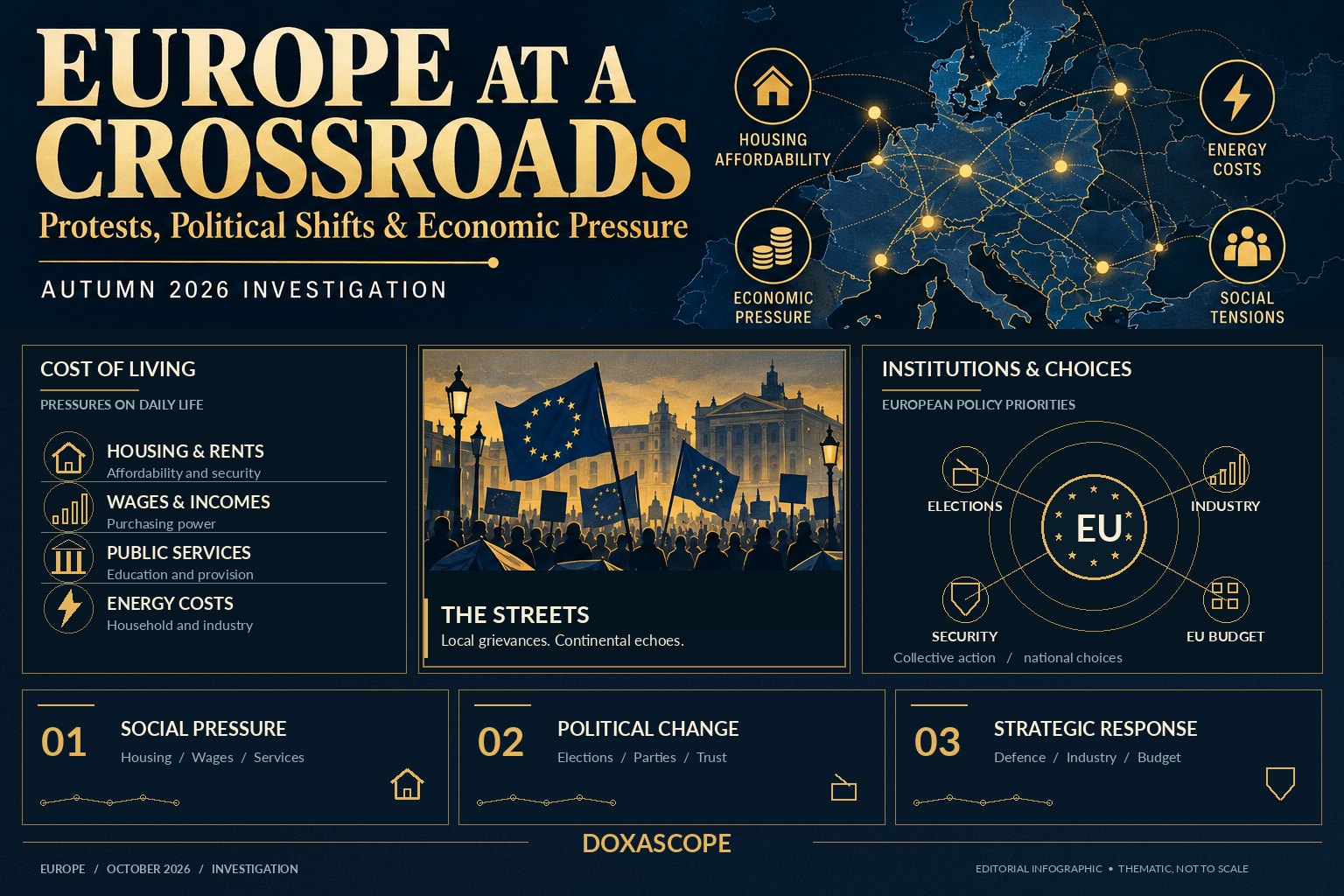
Europe in autumn 2026: the street asks for housing and wages, Brussels bargains over defence and budgets
Deeper than a season of demonstrations, and so far less than one European uprising
The read
Europe is seeing a striking wave of protest. The size of the crowds matters less than the timing. Three different movements are happening at once: social anger from below, a reshaping of the political map, and an attempt from above to rebuild Europe's economic and security power. Over the weekend of 17–18 October, France, Italy, Belgium and Portugal saw demonstrations and clashes of different sizes. Spain's housing crisis and the anti-government protests in Albania continued. These movements did not take one shape. Some stayed peaceful; some turned violent. No reliable evidence shows a shared leadership or central coordination. The closest reading: separate local crises that meet at the same points, which are the falling ability to afford daily life, pressure on public services, and weak political trust. All of this happens while the Russia–Ukraine war continues, and while global tension rises after the US and Israeli war on Iran. On the other side, EU leaders met on 15 and 16 October to discuss competitiveness, the budget, defence, Ukraine, energy, migration and enlargement. Put the daily demands of the street next to Brussels' strategic agenda, and you see how hard it is to share out the continent's resources and priorities at a moment of heavy pressure.
What is moving
France: the centre of escalation
The wave began in September in high schools in poor suburbs north of Paris, over missing teachers and run-down buildings. Unions and groups of "yellow vests" then joined, and the demands grew to include failing services and the rising cost of living. On 17 October, turnout was put at about 550,000 by the authorities and close to 800,000 by the organisers. Many gatherings were peaceful, but clashes, looting and arson took place in several cities, including a fire at Limoges town hall. By the toll announced on 18 October, arrests had passed 2,400, nearly 1,000 police officers had been hurt, and one protester had died during the unrest, according to early reports. The political weight grows as France's presidential election approaches in spring 2027.
Reuters — France protests coverage, 17 OctoberReuters via Internazionale — background to the protestsAssociated Press — 17 OctoberReuters — the 18 October toll
Spain: housing has become a question of government
The case of Maricarmen Abascal (87) became a symbol of the rent crisis. She was evicted from her Madrid home on 23 September after living there for 71 years, and she died on 7 October. Her case helped widen the mobilisation for tenants, and sit-ins followed in Madrid. Pedro Sánchez had announced on 5 October that he was dissolving parliament and calling a general election for 29 November 2026, two days before Abascal died, after a parliamentary deadlock and rejected social and housing protection bills.
EFE — report of 7 OctoberSpanish Prime Minister's Office — statement of 5 October
Portugal: a union march and a parallel housing crisis
On 17 October, tens of thousands marched in Lisbon at the call of the CGTP union confederation, asking for better wages, pensions and services, and for action on living costs. The police gave no independent count. At the same time, a housing mobilisation moved from Porto to the capital, where protesters pitched tents in Rossio square. House prices in Portugal rose 124% between 2015 and 2024, according to official data reported by AFP.
Reuters via Internazionale — the Lisbon marchAFP — the housing protests
Italy: clashes in Milan
In Milan, parts of the protests against living costs and failing services turned into clashes with police on 17 and 18 October. Security forces used tear gas, and there were reports of vandalism and looting.
Reuters via Internazionale — Milan, 17 OctoberReuters via Internazionale — Milan, 18 October
Belgium: students and unions against austerity
Students marched in Brussels on 17 October against rising education costs and reforms they fear will put higher education out of reach. Clashes broke out near the march. A wider union protest against austerity came before it, on 9 October. The peaceful union march and the clashes on its edges are two different things.
Reuters via Internazionale — Brussels, 17 OctoberEuronews — the 9 October protest
Albania: the street at the edge of EU enlargement
Albania is not an EU member, but it is a candidate to join. Student-led protests against poor schooling, unemployment and corruption grew into demands that Prime Minister Edi Rama resign, with violence in Tirana and other cities. They follow months of opposition to a disputed coastal tourism project linked to Jared Kushner. Rama said the escalation threatens the country's path into the EU more than it threatens his government. On 18 October the European Commission condemned the violence, and stressed the right to peaceful protest and the need for a proportionate response.
Reuters — Albania, 18 OctoberEuropean Commission — statement of 18 October
The numbers: inflation up, unemployment holding, gas volatile
Euro area inflation reached 3.8% in September 2026, up from 3.2% in August, with a large push from energy. EU unemployment was 6.1% in August 2026, and youth unemployment (under 25) was 15.4%, a share of the young labour force, not of all young people. The European gas benchmark stood at about 87 euros per megawatt-hour in mid-October, a moving market indicator tied to the war around Iran and disrupted shipping through the Strait of Hormuz.
Eurostat — inflation, 16 OctoberEurostat — unemployment, 1 OctoberFinancial Times — the rise in gas prices
Germany and Hungary: anger has no single colour
The Alternative for Germany (AfD) scored 29% in the national INSA poll published on 16 October. But in Berlin's state election on 20 September, the party won 16.25% of the list vote, against 25.66% for the Left party. A national poll and a local result are two different measures. In Hungary, Viktor Orbán lost the 12 April 2026 election to the Tisza party led by Péter Magyar, a centre-right party.
INSA — October pollBerlin election resultsReuters — the Hungarian election
Britain: practical closeness, not a return to membership
On 12 October, Prime Minister Andy Burnham called for a more serious conversation about the long-term relationship with the EU, and confirmed a UK–EU summit on 20 November 2026. What is on the table now is practical agreements on trade, energy and migration.
Brussels: the 15–16 October summit
Talks on the long-term budget (2028–2034) continued without a final deal. Leaders are pushing for a political agreement before the end of 2026, so the needed programmes can pass before the new funding cycle starts in 2028. Leaders restated financial and military support for Ukraine, and discussed defence readiness, the eastern border, hybrid threats and drones. Proposals covered deeper single-market integration, simpler procedures and lower energy costs. Migration stayed a sensitive file, and leaders restated that candidate countries, Albania among them, join on the strength of their progress in reform and the rule of law.
European Council — summit outcomeEuropean Council — conclusions on competitiveness, the financial framework and enlargement
Deep reads
The dilemma: street and summit compete for the same resources
The numbers do not show one identical recession across the continent. But rising housing and energy costs, and the strain on public services, carry more political weight than average growth or headline unemployment. Higher inflation means prices keep rising at a yearly pace; it does not mean prices were low and then jumped all at once. Citizens want better buying power, housing and services. Governments need money for energy, defence and infrastructure, and sometimes they also want to cut the deficit. The continent needs stronger states and European institutions to face outside threats, but their social legitimacy is tested by whether they can improve daily life. The two tasks can support each other or compete for the same resources, depending on the policies chosen.
A rising right, or a crisis of the traditional parties?
In France, the nationalist right may gain from the government's falling popularity and from the scenes of violence, while the radical left and the unions try to turn discontent into social demands. The size of a protest does not convert automatically into votes. In Germany, the AfD leads in the national poll while the Left outpolled it in Berlin. In Hungary, the fall of a nationalist leader did not mean a move to the left; the mood shifted to another conservative force. The nationalist right has growing chances in several countries, but the broader common ground is a crisis of trust in whether existing institutions can respond.
Three scenarios the coming months can test
Gradual containment: the unrest cools if governments offer specific answers on housing, education and wages, or if the energy shock eases; the mood may improve without the roots being fixed. The anger moves to the ballot box: the protests turn into a reshuffle of votes and coalitions, starting with Spain's election on 29 November, then the French contests in 2027. Overlapping escalation: energy prices stay high, strikes spread, new clashes break out and several governments hit crisis at once; the danger then is slow European decision-making. What is happening is deeper than a season of demonstrations, and so far less than one European uprising.
What we left out
Examined and dropped, with the reason. Codes are shown as written.
- UNVERIFIED-CLAIM
That this is one "European uprising" with a shared leadership or central coordination
No reliable evidence shows a shared leadership or central coordination. Issues, size and level of violence differ from country to country; the closest reading is separate local crises that meet at living costs, services and political trust.
- UNVERIFIED-CLAIM
That Maricarmen Abascal's death pushed Sánchez to call an early election
The order of events rules it out: Sánchez announced the dissolution on 5 October, and Abascal died on 7 October. The decision came out of a parliamentary deadlock and rejected housing and social bills.
- UNSTABLE-COUNT
One number that merges the size of the French protest with its toll
The 17 October turnout estimate (550,000 by the authorities, 800,000 by the organisers) is not the running toll announced by 18 October (more than 2,400 arrests). The protester's death rests on early reports, so the toll is still open.
- UNVERIFIED-CLAIM
That Britain is heading back into EU membership
The Prime Minister's statement speaks of a conversation about the long-term relationship, a summit on 20 November and practical agreements. Rejoining is not an announced decision.
- UNVERIFIED-CLAIM
That the whole movement is "a right-wing wave"
Some of the strongest action comes from unions, the left and housing movements, and the Left party outpolled the AfD in Berlin. The nationalist right's chances are rising in some countries, but the label does not cover the whole picture.
- UNVERIFIED-CLAIM
That defence spending caused the protests, or that competition with China and dependence on the US were summit decisions
The evidence does not show that defence spending directly caused any given protest; it makes the fight over budget priorities harder. China and the US are an analytical reading of the context, not decisions in the summit conclusions.
Coverage limits
This edition is an explanatory investigation dated 19 October 2026, not a live, continuing feed. Its window runs from the European Council summit on 15 October to noon on 19 October. Earlier events (Hungary's election in April, Berlin's election in September, the eviction of Maricarmen Abascal, the Brussels march of 9 October) are dated context inside the pulses. Eurostat data and documents from the European Council and the governments concerned serve as primary sources, with news agency coverage for events on the ground. Some Reuters reports are linked through their republished pages on Internazionale. We did not check social platforms for this edition; they are dark coverage, not evidence of no attention. The French toll is preliminary and may change. The full version of this investigation, with its tables, is also on Substack. Some research and assembly steps were done with the help of automated tools and agents; the final material then went through editorial review. Corrections and notes: admin@doxascope.com
Dark surfaces
- X
- TikTok
- Facebook (closed groups)
- Telegram channels
Direct sources
European Council — outcome of the 15–16 October summitEurostat — inflation, 16 OctoberEurostat — unemployment, 1 October