The Eternal Conflict
2026-06-29 · A.F. Sadek
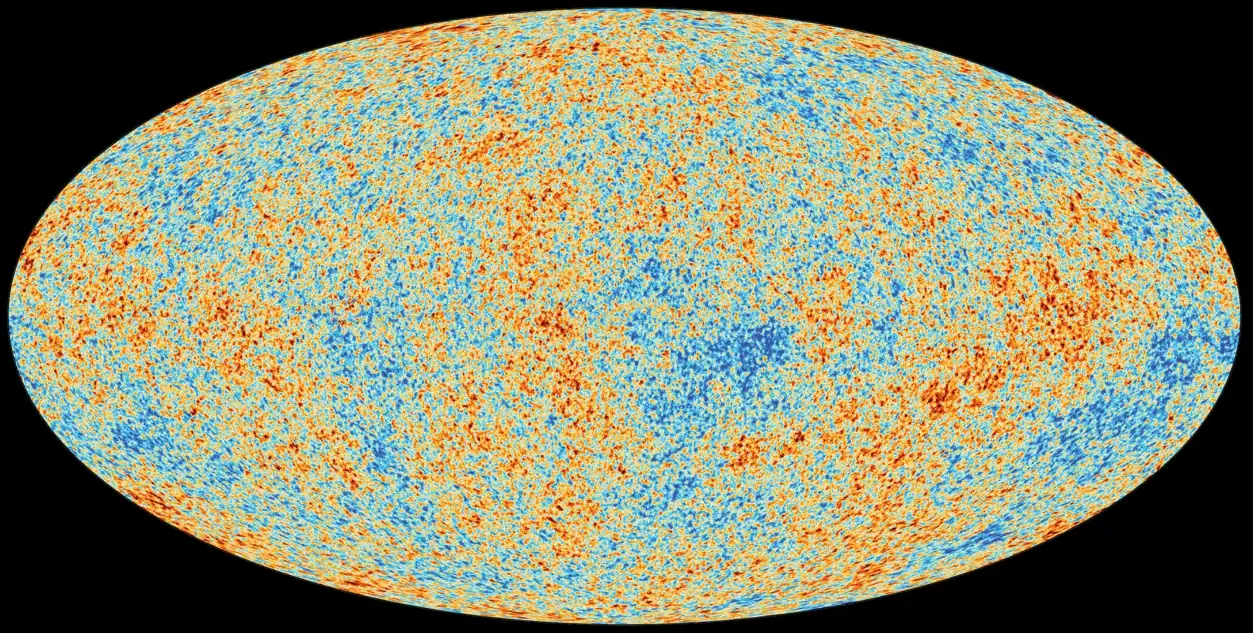
There is an eternal conflict that has never ended. It is not the struggle between good and evil, or even between charge and its opposite. The closest description is the conflict between existence and non-existence, or, in another register, matter confronting its “other.”
The physical picture is quieter than the word “conflict” suggests. Quantum fluctuations have never stopped. They are happening now, at every point in the fabric of spacetime, and they will continue as long as quantum fields exist. The pairs we sometimes describe as appearing and vanishing instantly know no “victory.” In that picture, they know only symmetry.
The useful question, then, is not: why did matter defeat antimatter?
The sharper question is: how did asymmetry become possible in a universe whose fluctuations were, and still are, perfectly symmetric and zero in net energy?
The Fluctuations That Never Sleep
In quantum field theory, the vacuum is not still. Popular language often pictures vacuum fluctuations as virtual particle–antiparticle pairs appearing and disappearing. More precisely, the fields themselves are never perfectly quiet; what we call a “virtual particle” is not a tiny observable object, but a way of calculating and describing interactions inside quantum field theory.
These fluctuations are part of the normal state of fields and continue today in every cubic centimeter of space, but they do not give the vacuum a net excess of matter or extractable energy. They involve every field in the Standard Model: quarks, leptons, gauge bosons, and the Higgs field itself.
The conflict, in this sense, is eternal. But it is a zero-sum conflict. It produces no net matter and changes no energy balance. Symmetry remains the rule.
The Moment Asymmetry Appeared
In the early universe the situation was different. There were not only virtual pairs but a hot plasma filled with real particles in thermal equilibrium. Most of them annihilated with their antiparticles almost immediately. Yet something happened that produced a slight excess: roughly one baryon for every billion photons.
This excess did not come from any “victory” of the virtual fluctuations. The virtual fluctuations remained perfectly symmetric. The excess arose from a dynamical, out-of-equilibrium process called baryogenesis, which requires three conditions first stated by Andrei Sakharov in 1967: violation of baryon number, violation of CP symmetry, and departure from thermal equilibrium.
We do not know exactly which mechanism satisfied these conditions. Leptogenesis, electroweak baryogenesis, or other models are all possible, but none has been confirmed. What matters is that the “victory” was not a change in the nature of the fluctuations themselves. It was a rare exception that occurred once, under very special circumstances.
The Four Forces and Symmetry Breaking
As the universe cooled and expanded, something else occurred. The forces we know today did not appear in the same form at extremely high energies. In the usual picture, we speak of stages of symmetry breaking: at the Planck scale gravity reaches the boundary where we no longer have a completed quantum description, then the strong force separates from the electroweak force in grand-unified scenarios, and later electroweak symmetry breaks into electromagnetism and the weak force.
This breaking is not an eternal property of the fabric. It is the result of thermal evolution. In models of eternal inflation or the string landscape, different patterns of forces may be realized elsewhere in the multiverse. Our observable universe, however, has a specific thermal history that began hot and dense.
Gravity, in particular, remains distinct: it is the geometry of spacetime itself, not merely a field living upon it.
What We Still Do Not Know
Before roughly 10⁻⁴³ seconds of cosmic time, inside the Planck epoch, current science cannot make reliable claims. The Standard Model and quantum field theory assume the existence of spacetime and fields. What lies before requires a completed theory of quantum gravity, which we do not yet have.
Proposals such as the no-boundary condition or eternal inflation attempt to avoid a singularity, but they remain speculative. Even virtual fluctuations presuppose spacetime. Before that: a region scientifically unknown, and a space open to theoretical construction.
Why This Matters Outside Physics
The remaining picture is not one of victory but of continuation.
Vacuum fluctuations did not become a victorious army. Symmetry is not an enemy that gets defeated; what happened is that very special conditions allowed a small asymmetry to appear, and this asymmetry then grew into everything we see: atoms, stars, galaxies, and life. Dark matter, whose nature we still do not know but which seems to have been present early in cosmic history, helped build the scaffold on which large-scale structure was later hung.
Yet the fundamental conflict, the creation and immediate annihilation of virtual pairs, continues everywhere around us. It has not ended. It has not been resolved.
There are things in the universe we know through their continuing effect. And there are conflicts that appear zero-sum at the deepest level, even when they produce rare exceptions that change everything.
This is not a canon statement about Doxascope, and not an attempt to make physics prove the fiction. It is only the kind of image the work keeps turning toward: a system that does not promise justice, yet sometimes allows a tiny difference, under brutal conditions, to become a world.
Sources
- Sakharov, A. D. (1967). Violation of CP invariance, C asymmetry, and baryon asymmetry of the universe
- Planck Collaboration (2018). Planck 2018 results
- Particle Data Group (2024). Review of Particle Physics
- Weinberg, S. Cosmology
- Kolb, E. W. & Turner, M. S. The Early Universe
Hero image: Cosmic Microwave Background seen by Planck. Public domain, courtesy ESA and the Planck Collaboration.