A Forensic Autopsy of Cosmic Silence: Why Haven't We Found a Trace Yet?
2026-10-26 · A.F. Sadek
The results are conditional on the model and have not undergone external academic peer review.
1. America Finds the Aliens Again
Every few years the same cycle repeats in the same order: a congressional hearing, a witness with a confident tone, a shaky black-and-white video of a thermal dot that moves strangely, and a big headline that says the government "finally admits it". Then the public does the rest.
What the public does, specifically, is a chain of four leaps, all taken in a single sentence:
unidentified → anomalous → technological → non-human → extraterrestrial.
Each arrow in this chain deserves a separate examination, but the public crosses it without one.
Let us look at the first arrow: "Unidentified" is an administrative term. It means that the available data was not enough to decide. It describes the state of our file, not the nature of the object. A badly calibrated radar, a front lens that makes a halo, a thermal camera that loses its calibration, a pilot who judges distance by eye in a featureless sky: each of these produces a genuine and honest "unidentified", even if everything in the sky was made on Earth.
Our rule here: we will not mock the witnesses; many of them saw something real. What we reject is the unsupported leap from one link to the next.
And a greater puzzle remains: if ancient civilizations arose and kept spreading among the stars, why have we found no trace? This article examines what we can infer from that silence and what remains unknown.
2. We Have Seen This Film Before
In the summer of 1947, a pilot named Kenneth Arnold saw objects that moved "like saucers skipping across water". The press shortened the description to "flying saucers", and so was born the shape that people would see in the sky for eighty years. Then came the Roswell wreckage, and then thousands of reports.
When the US Air Force investigated officially through Project Blue Book, the final tally was 12,618 cases. Of these, 701 remained unexplained, and there was zero evidence of an origin beyond Earth.
The two numbers 12,618 and 701 carry the whole story. That about 6% of reports remain unexplained is expected; it would be astonishing if everything were solved. A large set of fleeting observations, with inconclusive measurements and witnesses who have no reference for distance, must leave some cases unexplained. To turn the lack of an explanation into evidence of aliens is to turn the limits of your instruments into a discovery.
3. Fermi Comes In Through the Same Door
In the summer of 1950, at Los Alamos, Enrico Fermi was walking to lunch with colleagues. They were joking about a cartoon in The New Yorker that blamed extraterrestrials for stealing the city's trash cans. In the middle of the conversation, after a silence, Fermi asked:
"Where is everybody?"
We should be precise here, because the history itself has become part of the legend. That question was not a research paper, not even a written calculation. It was a spontaneous question over lunch, from a man who habitually made quick, approximate calculations in his head.
What turned the question into an argument came later: Michael Hart (1975), then Frank Tipler (1980). Their argument goes deeper than radio and flying saucers.
If one old civilization sent out ships, and each new colony became a starting point for further journeys, settlement would spread from star to star. Then settling the whole galaxy takes only a few million years, a passing moment in the history of our galaxy, the Milky Way, which is more than 13 billion years old.
Since they are not here, Hart and Tipler concluded that they do not exist. This contradiction between "they should be here" and "we find no one" is what is called the Fermi paradox.
This argument is what we will dissect, not the shaky videos.
4. Let's Throw the Flying Saucers Out the Window
Let us assume, for the sake of argument and with full generosity, that every sighting of an unidentified anomalous phenomenon (UAP) in history has an earthly explanation: a drone, a balloon, a satellite, a lens fault, or a misjudgment by a tired person.
Does the question die with that?
No. When we throw the flying saucers out the window, we lose only the noise, and the question remains. Hart and Tipler's argument does not need a single witness or a single video. It needs only an old galaxy, the possibility of travel between stars, and an absence of traces.
This is where the autopsy begins.
5. Worlds Billions of Years Older Than Earth
The Sun is a late star. It is 4.6 billion years old, while the Milky Way's disk formed billions of years before that. When the first generation of stars began to die, they seeded the gas with what had not existed before: iron, silicon and oxygen, the building materials of rocky planets.
We have a tangible witness called Kepler-444: a star system about 11.2 billion years old, with five planets smaller than Earth around its star, likely to be rocky. These planets existed when the universe was less than a fifth of its present age, and more than six billion years before Earth formed.
Let us separate three things here:
age of the planet ≠ age of life ≠ age of technology.
The age of a planet tells us one thing only: how much time was available. To find out how long life takes to appear, then complexity, intelligence or technology to arise, and how these times vary between worlds, we need examples from multiple worlds. We have one sample: us.
So what we take from Kepler-444 is that small planets, likely to be rocky, began to form early. Any claim about when life or technology might have arisen there, or whether enough time remained for expansion, requires additional assumptions.
6. The First Objection: "Maybe They Haven't Arrived Yet"
This is the most popular objection to Fermi. It is valid when the visit is a response to our signals.
Imagine a civilization that picks up our radio broadcasts and then decides to send a ship. Our signal needs time to reach them, then their ship needs time to reach us. Humanity has been broadcasting for only about a century. This confines any "visitor responding to human technology" to the immediate stellar neighborhood, a few tens of light-years, even if its ship travels close to the speed of light.
There is another limit. Our waves have reached much farther than the distance at which anyone can pick them up. Our ordinary radio leakage fades quickly with distance. With instruments like ours, it becomes indistinguishable from noise only a few light-years away.
Our strongest emissions (such as the radars we aim at planets, and the giant antennas we use to talk to our distant spacecraft) are much clearer, but they are directed and intermittent: a narrow beam that points in one direction for moments.
So the hypothesis "they picked up our broadcasts and sent a ship" concerns a nearby stellar neighborhood: time limits the journey's range, and weak signals narrow it further.
7. A Signal Older Than Radio
A distant civilization might find a reason to take an interest in Earth long before humans appeared.
Living things filled Earth's air with oxygen, over a history that predates humans by billions of years. A distant observer who analyzes Earth's light might see this oxygen and find a possible sign of life. The chance of detecting oxygen depends on its amount, the distance and the observer's instruments. Interpreting it as a sign of life requires examining other possible explanations.
If Earth's oxygen has been detectable for about half a billion years, the time available for a response expands from a century of radio to hundreds of millions of years. A probe might also survey stars one by one for exploration, finding Earth during its search.
Lack of time is no longer a general explanation.
8. The Ship Is Not the Front
How do we calculate the time a civilization needs to settle across the galaxy?
A ship reaches a star, and the arrivals found a colony. After a while, the colony sends ships to other stars, and the new colonies repeat the journey. This is how settlement spreads from star to star. We call the leading edge of this spread the "expansion front". The speed of a ship sets the time of one journey; the speed of the spread also depends on how long each colony needs before it sends the next journey.
We use the "Aurora" model (Carroll-Nellenback et al., 2019) to represent this process under its assumptions, and it has two ideas:
The first idea: the stars themselves move. At speeds of tens of kilometers per second, stars change places constantly. So even if your ships are slow and short-ranged, new neighbors come to you. In this model, stellar motion therefore sets a minimum speed for the spread, as long as the spread continues.
The second idea: colonies rise and then end. For the spread to continue, colonies usually need to found new colonies before they lose the ability to send ships. If they mostly end before that, the spread stops.
The result: in many cases inside the model, the galaxy stays inhabited without every place in it being inhabited all the time. Some regions can stay empty of colonies for very long periods, while settlement continues elsewhere. These gaps are part of the cycle of colonies forming and ending. We may live in one of those regions.
9. Who Arrives First?
The galaxy is very old. Is its age enough for a civilization to spread from star to star until it reaches across it? That is what we calculated in this section. But note from the start: the calculation tests a possibility; it does not tell us that a civilization actually arrived.
To calculate, we assumed two things. First, that civilizations spreading colonies arose in the galaxy early, billions of years ago, and that there were at least ten of them. Second, that their colonies kept founding new colonies, as described in the previous section. We do not know whether this happened. We ask: if it did, what does the silence mean?
If these two assumptions held, time would be enough: in our calculations the spread of the first civilization would reach our region of the galaxy in almost all the cases we calculated, usually billions of years ago, and sometimes before Earth itself formed.
This means the part of the galaxy we live in, not our planet: reaching the neighborhood does not mean entering the house, or staying in it.
Why is time enough? Imagine a runner who starts hours before the others. A latecomer may be much faster, and the first runner still keeps the lead. This is what we found: when the first civilization appeared decided the arrival time far more than the speed of its expansion. Even when we raised the speed of the spread about 300 times, the arrival came only a little earlier.
In this problem, rockets do not decide the matter. The galaxy is small on a clock of billions of years.
So, if expansionist civilizations arose early and kept spreading, time alone does not explain why we have not found their traces. Three questions remain: did colonies form in our Solar System, and how long did they last? Did their traces survive until today? Can we detect them? These are the rest of the article. The detailed numbers for this section are in the "Numbers and conditions" appendix at the end.
So the question is no longer "Could they have arrived?" It became:
If they arrived three billion years ago… what would remain of them for us to see?
10. Solar System Archaeology: The Ladder of Deep Time
We turn to the question of trace survival. Here we add a question from archaeology to the expansion calculations: how old is the trace we are looking for?
The kind of evidence that can survive changes with the age of the visit:
- 10 thousand years: almost everything is still possible. An object on the surface of the Moon, a probe in a nearby orbit, a clear surface trace.
- 100 thousand years: time starts its work. Micrometeorites overturn the top two centimeters of lunar soil about every 81 thousand years. Fine surface details are erased; large objects may survive.
- 1 million years: we do not know how a device left exposed on the Moon for this long would look, so we have no tested way to recognize it. Buried objects become more important, though searching for them is difficult.
- 10 million years: in our Mars example, slow erosion wears away about a meter of the surface over this period. A meter-sized trace on the exposed surface may be erased.
- 100 million years: the orbits themselves betray. Near-Earth objects orbit the Sun and approach Earth's orbit; they are not satellites orbiting our planet. Their time in these orbits may end through collision or ejection over tens to a hundred million years. We have no right to expect that an object that arrived 100 million years ago is still in the orbits we search today, even if it remains intact.
- 1 billion years or more: here we ask: did a buried object survive? Did a stable orbit keep an object? Did a trace survive on outer-system bodies, or a huge trace that lasts a long time? Each possibility has its own conditions. A stable place alone does not prove that a machine survived there, or that we would recognize it if we found it.
11. The Search Map: Where Have We Actually Looked?
Now we put the previous ladder next to what we have actually searched. The question: where can our instruments find a trace if one exists, and where are they weak?
The surveys we draw on studied boulders, asteroids and other natural objects. We borrow their sensitivity to ask: if an artificial object with similar properties existed, would they have detected it? Recognizing it as artificial is a separate step.
The Moon: extensive images, and better knowledge of boulder detection. The images used by the study cover most of its surface between latitudes 60 north and 60 south. The study counted boulders, and we assume that a machine the size of a boulder would look like one in the images.
An image consists of small units called pixels. Our calculation uses the detection measurements for objects three pixels or more in diameter in the image, so it covers these sizes and larger ones.
The lunar soil churns slowly from the top, but that does not erase a machine several meters long at the same speed.
Mars: we have searched little. High-resolution images cover less than 3% of the planet, and they were chosen for geologically interesting places, not at random. The radar that sees below the surface passes over more than half the planet, but in widely spaced strips; if we require closely spaced strips, coverage falls to 8% of the planet.
Near-Earth asteroids: we have searched well. Our catalogue is excellent for large objects, and weaker the smaller the object.
Earth's L4 Trojan point: a region on Earth's orbit where an object can travel along with Earth. A recent survey covered locations where simulations predict about a third of these objects would be found. The survey detects large, bright objects well, and its ability drops quickly as objects get smaller and fainter. It found no new Earth Trojans.
The outer Solar System: we have searched part of the sky. The survey we rely on covered about an eighth of the sky, and detects bright objects better than faint ones. Our calculation here is optimistic: we assume that objects are spread evenly across the sky. Objects may cluster in places where the survey's coverage is weaker.
Active probes: if a probe broadcasts the way our spacecraft do, the beam it transmits covers a tiny part of the sky at any moment. Catching it by chance is a matter of luck.
Now put the ladder next to the search map:
The environments that might preserve traces for billions of years (buried depths, ultra-stable orbits, dark outer regions) are the ones we have searched least effectively. The exposed lunar surface, covered by extensive images, changes faster.
We search carefully under the streetlight, and the key, if it fell at all, may be in the dark.
12. What Does a Search That Found No Trace Tell Us?
Imagine a fisher who casts a net in one corner of a lake and pulls it up empty. Is the lake empty of fish? Perhaps. Or the fish are few, or in another corner, or the holes in the net are wider than the fish. The catch alone cannot tell these possibilities apart.
The search for traces has the same problem. When we find nothing, four questions stay open together:
- Did colonies form in our Solar System, and how long did they stay active?
- How many traces do those colonies produce?
- How many of the traces lie in the places we searched?
- Do the traces survive, and would we recognize them if we saw them?
These possibilities can lead to the same result: a search that returns without a trace. If a civilization placed most of its traces deep inside outer-system bodies, the search on the Moon would be far from most of what it left. However often we repeat searches in the same places, they will not tell us how many traces the civilization left in total, as long as we do not know where it places them.
So when does silence become evidence? When we assume a specific scenario, and then calculate: if it were true, would we have found something?
One piece per settlement, or traces that keep building up?
How does a civilization leave traces? We test two pictures: a ship that lands at each settlement and leaves one piece, or a city that leaves waste behind every day for as long as it stands.
In each picture we ask: if this scenario were true, what is the chance that we find at least one trace? If the chance is high, 95% for example, and we found nothing, the scenario is hard to reconcile with what we observed. This does not mean that the chance that aliens exist is 5%; it only means that this particular scenario has become weak.
In the ship picture, the civilization leaves one piece at each settlement. In most cases we tested, the chance of finding a piece stays below 95%, even assuming that we detect and recognize every surviving piece. A perfect survey would detect every surviving piece, but the model also allows a probability that our system contains no surviving piece. Non-detection therefore cannot exclude those cases at this threshold.
In the city picture, traces build up, and the more there are, the better the chance of finding one. Here silence can exclude some cases, but under conditions we will now see.
In one sentence:
This framework shows when the absence of traces is not enough to exclude a scenario, and what we must assume for it to be enough. It does not turn that into proof that civilizations exist or do not exist.
An Example: Traces Among Near-Earth Asteroids
Take the example of bright traces among near-Earth asteroids. These are very bright traces: if they reflected light the way asteroids do, they would be a few kilometers across. Imagine a civilization that keeps leaving traces over the last 100 million years. We choose the last 100 million years here as a reference window for comparison. Whether traces from the preceding billions of years survive depends on their location and orbit, as we saw in the ladder of time. If its average production rate in that region were about one trace every 32 million years, the probability of finding at least one would reach about 95%, inside the model and under the conditions below.
This example is deliberately optimistic. Its colonies stay active for the whole period and leave all their traces among near-Earth asteroids. The traces stay intact and in the orbits we search, bright enough to detect, and we recognize them when we see them. If any of these conditions breaks, the inference weakens.
Because we found no artificial trace, we can rule out an average production rate there of more than one trace every roughly 32 million years, provided all those conditions hold.
If instead we assumed that traces remain detectable for ten million years on average, we would need production about ten times faster: roughly one trace every three million years, with the other conditions unchanged.
Each survey can detect objects with different properties, depending on their size, brightness and distance. Each result concerns the objects we calculated for that survey. In our examples, the surveys of other environments required a higher production rate to reach the same detection probability. So this comparison does not say where the same spacecraft would be easiest to find. Examples of the objects and their production rates are in the appendix.
All these numbers say one thing: our silence tests the trace production rate under specific conditions; it does not settle whether the civilization exists. The inference weakens if production is low, the traces lie elsewhere, or they did not survive.
You can try this yourself in the inspection window: pick a place, change the trace's brightness or size, and see where the survey weakens. The full calculation, with its units and conditions, is in the "Numbers and conditions" appendix at the end.
13. Conclusion: The Paradox, Cleaned Up
Let us return to where we began: the congressional hall, the shaky video, the confident witness and the big headline.
The question "Where is everybody?", in Hart and Tipler's form, does without all of that: without Pentagon leaks, without wreckage in the Nevada desert, without the dissected body on YouTube. The real puzzle begins after we leave all this behind and sit in front of the bare calculation.
And when we sit down, we find that one word, "silence", was hiding four quite different things:
- Signals whose beam may never cross our path (a narrow radio beam, not full-sky coverage).
- Visits in reply to our radio broadcasts whose time has not yet come (our broadcasts are only a century old).
- Traces that may erode or become buried, and may leave the orbits we search over time.
- Places where the search remains limited: high-resolution images of Mars cover less than 3% of its surface, and the imaging sites were chosen for their geological interest, not at random.
All this takes apart the simpler version of the paradox. But it does not kill the problem; it only cleans it:
If an old, expansionist, long-lived technological civilization arose in our galaxy, kept occupying our Solar System, and produced lasting traces where our surveys could detect them… then where is its trace?
This is the version of Fermi after the autopsy: a clear map of conditions, where we name our assumptions, give the sources of our numbers, and identify what we do not know.
And the difference between the two versions is the difference between staring at the sky and wondering, and knowing exactly what you do not know.
(And this is where the real research begins.)
A question outside this investigation: why the Milky Way alone?
Why do we talk only about our galaxy, when the universe holds trillions of galaxies?
Because three questions are usually mixed into one, and they are physically different:
- Existence: is there life somewhere? A vast universe raises the odds of this statistically.
- Detection: can we see its trace? This is possible across huge distances if the trace is large enough.
- Contact or visit: can one of us actually meet the other? This is governed by the speed of light.
Andromeda, the nearest large galaxy, is about 2.5 million light-years away. If we sent a message at the speed of light and it were answered at once, the round trip would take about five million years. This makes dialogue impractical on the scale of our civilization; but it does not prove that a probe launched in the distant past cannot arrive. That is another question, which our local model does not calculate.
So the vastness of the universe does not automatically strengthen the case for a local visit. It adds possible sites for life, but turning them into visits or replies needs another calculation of distance and time. The Milky Way is our main laboratory. Light crosses it in about 100 thousand years, while its stars are billions of years old. A small part of its history may be enough for an expansionist civilization to spread through it, in the cases we tested. Other galaxies remain legitimate targets for very bright signatures and large-scale activity, even when dialogue with them is impractical.
The galaxy is the stage of the current investigation; what lies beyond it needs other tools and other calculations.
Appendix: numbers and conditions
This appendix is for readers who want the calculation itself. The main text carries the story; here are the numbers, units and conditions as in the research.
Section 9, who arrives first:
- "Ten or more civilizations" is the smallest number in our main calculation. Under this condition, and under the emergence assumptions we tested, the spread reaches our region of the galaxy in almost every case.
- The first arrival typically falls 2.6 to 7.2 billion years ago, depending on what we assumed about when civilizations begin to appear. The oldest part of this range predates the Solar System; so it describes the spread reaching this region of the galaxy, not a visit to Earth.
- Where does this great age come from? In some cases we tested stars up to 13.2 billion years old, and assumed that technology needs 6 or 10 billion years after the star forms. Civilizations could then begin to appear 7.2 or 3.2 billion years ago, and the first arrival falls a little later: between 6.5 and 7.2 billion years ago, or between 2.6 and 3.2 billion. These are limits we set in the calculation, not dates we observed.
- Speed: we raised the speed of the spread from 60 km/s to about 17,600 km/s, roughly 300 times faster, and the typical arrival moved earlier by only about 170 million years. This is a change in arrival time when speed changes, not the time to cross the galaxy.
- Earlier work has studied parts of these questions; we name the closest in the note on sources.
Section 10, the ladder of deep time:
- The Mars example uses a reference erosion rate of about 100 nanometers per year. If this rate continues for 10 million years, erosion removes about a meter. The calculation assumes the rate persists throughout the period.
Section 11, the search map:
- The Moon: the images used by Aussel et al. (2025) cover 97.1% of the surface between latitudes 60 north and 60 south. The detection method finds 76% of natural boulders whose diameter in the image is three pixels or more. Our calculation uses detection measurements from three pixels up, so our model does not count detections of smaller objects. Micrometeorites overturn the top two centimeters of soil about every 81 thousand years.
- Mars: high-resolution camera images cover 4.5% of the planet if we add up their areas, and less than 3% counting each place once. The SHARAD radar covers 55% of the planet if we count an area as covered when neighboring strips are 3 kilometers apart or closer, and 8% if we require them to be no more than half a kilometer apart.
- L4: a recent survey covered locations representing about 33% of the probability of finding stable objects, under their simulated distribution. Brightness is measured by absolute magnitude: a larger number means a fainter object, and usually a smaller one. The survey's sensitivity starts to fall beyond a magnitude of about 18: about 12% at 19.5, about 2% at 20, and close to zero at 20.4.
- The outer system: the Dark Energy Survey (DES Y6) covered about 5,000 square degrees of sky. We built a simplified simulator of how this survey picks up objects, and compared it with its published performance. When we assumed that objects are spread evenly across the sky, the survey's chance of finding them came out about 1.6 to 2.2 times higher than its chance when we tested specific groups of orbits; so we call the outer-system estimate optimistic.
- Active probes: the beam of a probe that broadcasts like our spacecraft covers about 0.002% of the sky at any moment.
Section 12, what does a search that found no trace tell us?
- The ship picture: in about 86 of every 100 combinations of model assumptions we tested, the chance of detection does not reach 95%, even assuming that every settlement leaves a trace and that we detect and recognize every surviving trace, under the tested survival assumptions. The limits here depend on the number of settlements, including every return after a gap.
- The city picture: in near-Earth asteroid space, an average production rate of about one trace every 32 million years gives about a 95% probability of detecting at least one trace inside the model, under the conditions below. This is a threshold for an average production rate, not a fixed number of objects known to exist. Non-detection lets us exclude production rates above the limit calculated at this threshold.
- The full conditions for this result: we count traces that built up over the last 100 million years; the trace neither decays physically nor leaves the observed class during this period; the colonies stay in place in almost all systems suitable for settlement; they leave all their traces in the search region under study; we count bright traces that the survey can detect easily; and we recognize the trace if we see it.
- If production is lower than the required rate, the chance of detection falls below 95%, but it does not become zero.
What do these rates compare?
Each result concerns a different class of traces, at a specified point on the survey's measurement scale. The table does not test the same spacecraft in four places or rank places by their ability to detect a probe of one size. For the Moon we specify object size and image resolution; for asteroids and L4 we specify absolute magnitude H; for the outer system we specify apparent brightness mᵣ.
A perfect survey that missed nothing would need about one trace every 33 million years. The table shows each survey’s performance for the trace class specified: the asteroid survey almost matches the perfect survey, while the outer-system survey needs about nine times more production.
| Search environment | Specific example from model outputs | Mean production interval at the 95% threshold | Mean number produced over 100 million years |
|---|---|---|---|
| Near-Earth asteroids | H = 15.5 | One trace about every 31.7 million years | About 3.2 |
| Lunar surface | Diameter 4.5 meters, in an image at 0.5 meters per pixel (the model’s best case) | One trace about every 24.4 million years | About 4.1 |
| L4 | H = 15.5 | One trace about every 10.4 million years | About 9.6 |
| Outer system | mᵣ = 20 | One trace about every 3.8 million years | About 26.2 |
These are examples from the same reference case in the model outputs, under the occupancy, survival, placement and recognition assumptions stated above. The last column gives mean production counts, not numbers of pieces known to exist. The outer-system example still assumes that traces are spread evenly across the sky.
Converting brightness to diameter requires assumptions about how much light the object reflects and its shape; converting apparent brightness also requires its distance. We therefore keep the surveys' original measurement scales here and do not assign one size to an unknown trace. The NASA/JPL asteroid size estimator explains how a diameter estimate from H depends on assumed reflectivity and shape.
How does the survival assumption change the result? In the same near-Earth asteroid example, at H = 15.5, an assumed mean survival time of 10 million years gives a production interval of about 3.17 million years, rather than 31.7 million years with no loss of traces. The calculation assumes that the probability of a trace remaining detectable decreases exponentially with its age, and integrates the surviving traces over the 100-million-year window. The ten million years is an assumed mean, not a median lifetime or a deadline when all traces disappear. This is a general survival sensitivity test, not a separate calculation of object trajectories and orbital escape.
Where does the lunar number come from? The model calculates two image-scale cases: 0.5 meters per pixel (best case), and 1.5 meters per pixel (conservative bound). A 4.5-meter object spans nine pixels in the best case. At this point the model uses 87% detection efficiency, not the 76% value for the three-pixel threshold. It also multiplies coverage by the area factor for the band between latitudes 60 north and 60 south: about 0.866 of the lunar surface, assuming traces are spread uniformly over the surface. Thus, approximately: 33.4 × 0.971 × 0.87 × 0.866 = 24.4 million years. At the conservative bound, the same object spans three pixels, giving 76% detection efficiency and an interval of about 21.3 million years. These are reference cases, not a measurement of the images’ actual average performance. Deliberate placement at the poles needs a different assumption; this comparison does not represent it.
What does the 100-million-year window mean? We hold this duration and the survival assumption fixed to make a reference comparison. This choice does not establish that a trace would remain in an orbital class for the whole duration, or determine which environment preserves traces longest in reality. The example assumes no loss of traces from the search class; it does not calculate orbital escape separately. Changing survival or the accumulation time changes the required production rates.
A Note on Sources and Auditability
The numbers come either from recorded observational and historical sources, or from model outputs under stated assumptions. A reproducible calculation does not prove every hypothesis. So we distinguish between results, scenarios, and the data that each party verified:
- The astrophysical model: Carroll-Nellenback et al. (2019), for the expansion network and the steady state.
- Observational numbers: from papers published between 2021 and 2026 on the coverage of the Moon and Mars, asteroid catalogues, Trojan and outer-system surveys, and beam limits.
- Where this work stands among others: Pan et al., v1, a preprint estimates a likely upper limit on the number of probes that could reside in our system, based on what has been searched in seven regions and on assumptions they state, and discusses how much the result depends on those assumptions and the limits of identification. Here we study the link between arrival, occupancy, survival, detection and the two trace-production assumptions. This is a comparison of scope and method, not a claim of absolute priority; the full-text comparison is in the research package.
- Transparency: the research package records, for each number, who verified it personally in the original text, and it separates clearly what an independent reviewer audited from what the researcher transcribed.
- Reproduction: one script rebuilds the stated outputs from the configuration and reference assets, with deterministic check suites. The audit recorded two byte-identical runs.
- Error log: the project went through an independent adversarial review that corrected real mathematical errors. All of them are recorded, with their numerical effect, in the audit report inside the research package, rather than hidden.
The research package (code and data) is available on request from the Aliens-Scope page.
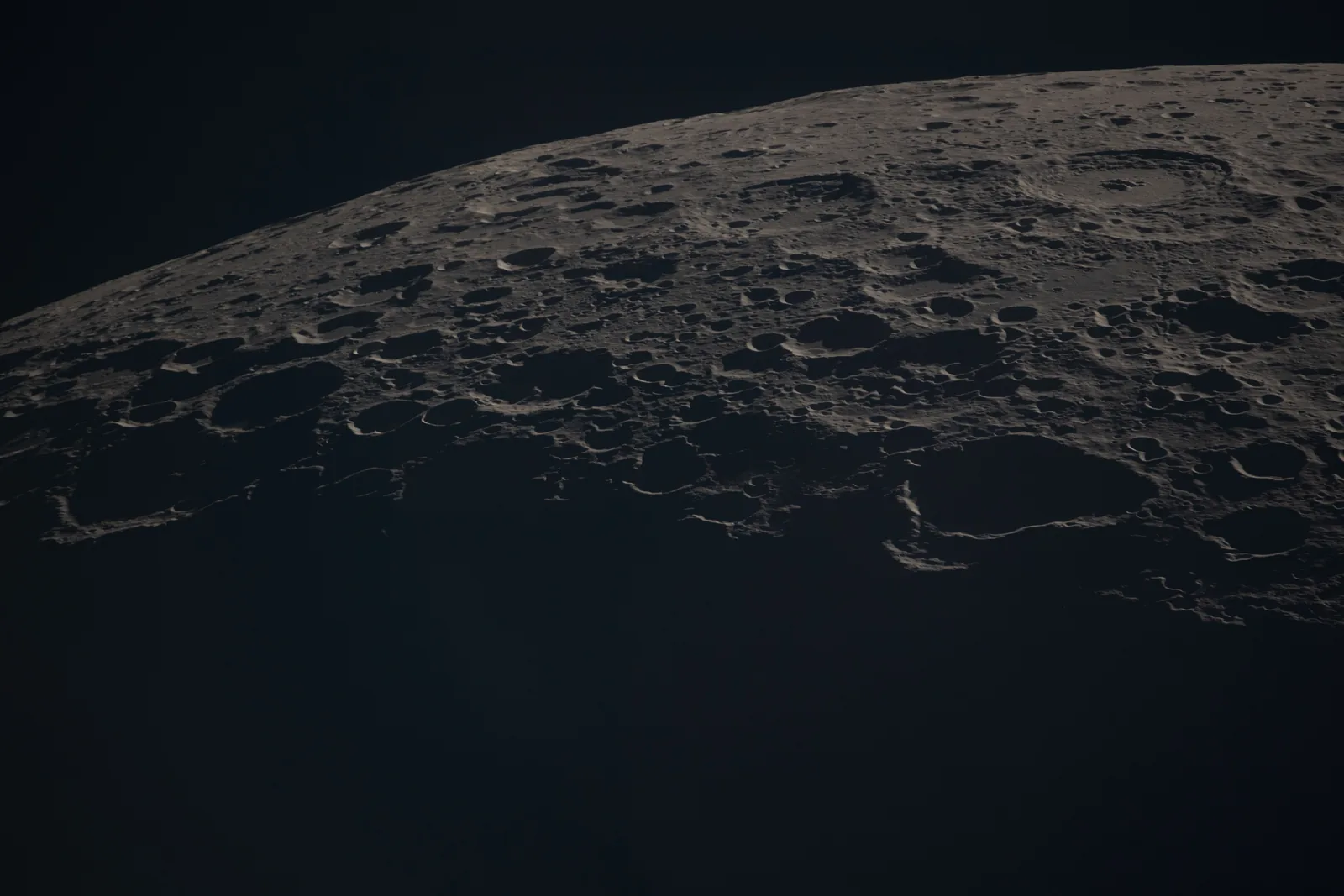
Cover image: the lunar terminator, the line between lunar day and night, photographed by the Artemis II crew on 6 April 2026. Source: NASA, public domain. Resized and converted to WebP.
References
- Project Blue Book: US Air Force fact sheet
- Kenneth Arnold, 1947: Flying saucer
- Jones (1985): "Where is everybody?" An account of Fermi's question, LA-10311-MS
- Hart (1975): An Explanation for the Absence of Extraterrestrials on Earth
- Tipler (1980): Extraterrestrial Intelligent Beings do not Exist
- Campante et al. (2015): An ancient extrasolar system with five sub-Earth-size planets (Kepler-444)
- Reinhard et al. (2017): False Negatives for Remote Life Detection on Ocean-Bearing Planets
- Sheikh et al. (2025): Earth Detecting Earth, Astronomical Journal
- Carroll-Nellenback et al. (2019): The Fermi Paradox and the Aurora Effect
- Speyerer et al. (2016): lunar regolith overturn, Nature
- Kite & Mayer (2017): Mars sedimentary-rock erosion, Icarus
- Gradie & Tedesco (1987): The 1986 DA and 1986 EB: M-class asteroids in near-Earth orbits, NASA NTRS
- Aussel et al. (2025): lunar boulder detection, JGR Planets
- McEwen et al. (2024): HiRISE coverage, Icarus 419, 115795
- Putzig et al. (2024): SHARAD coverage, Icarus
- Nesvorný et al. (2024): NEOMOD 2: An updated model of Near-Earth Objects from a decade of Catalina Sky Survey observations, Icarus
- Lu et al. (2026): WFST search for Earth Trojans at L4, arXiv:2606.31751
- Bernardinelli et al. (2022; preprint 2021): A search of the full six years of the Dark Energy Survey for outer Solar System objects
- Lazio (2026): Solar System Technosignatures, arXiv:2606.13797
- NASA: Andromeda (Messier 31)
- Pan et al. (2026, preprint v1): A Bayesian framework for posterior bounds on self-replicating probes in the Solar System under observational incompleteness