After Death
2026-07-11 · A.F. Sadek
I am not afraid of the question of what comes after death. I am afraid of the easy answers offered in its name.
Our instruments can tell us what happened to a body: the heart stopped, blood flow ceased, a response disappeared, or a brain function was lost. They do not measure the thing we actually want to know: did the subject of the experience end, or did something remain?
This is where an old temptation appears. We turn the failure of measurement into evidence for the answer we already wanted. A story may offer comfort, terror, or the appearance of reason by putting on a white coat and borrowing the language of the laboratory.
But the comfort of an answer says nothing about whether it is true.
So I do not begin with the familiar question: what is there after death?
I begin with a narrower, harder one:
What was actually measured, and what did we add to the reading?
Not Every Stoppage Is Death
In ordinary language, death looks like a clean point: a person was here, and then they were not.
Medicine has to be more precise. Cardiac arrest means that circulation has stopped, but resuscitation may reverse it. A coma is not death. A lack of response does not, by itself, establish the absence of all brain activity.
In 1968, an ad hoc committee at Harvard Medical School proposed “irreversible coma” as a new criterion for death. The proposal was a response to a change in medical technology. Ventilation and other forms of support could keep a heart beating in a body whose brain functions had been permanently lost. Medicine needed sharper language for a condition created by its new ability to sustain the body.
Modern standards are more detailed and conservative. Determining death by neurologic criteria, commonly called brain death, requires a careful clinical assessment. The determination begins with a known catastrophic brain injury. It requires permanent coma, the loss of brainstem function, and the inability to breathe spontaneously under an appropriate test, while excluding drugs and conditions that can imitate those signs.
The changing definition does not mean death is an illusion, or merely “the point where the instrument stops.” It means one word had been hiding several different processes, and better tools forced us to draw a more accurate map.
That distinction matters. Recording activity during cardiac arrest is not the same as recording consciousness after brain death. Resuscitation is not an experiment on the afterlife. It is an attempt to keep the process of dying from becoming permanent.
What Do Instruments Find at the Edge?
The brain does not always fall silent all at once. Instruments sometimes find real signals near the edge, but the measured fact is much smaller than the stories built around it.
In 2013, researchers induced cardiac arrest in nine anesthetized rats and recorded their brains. For roughly thirty seconds after the heart stopped, they observed a brief rise in the synchrony and connectivity of some gamma-frequency activity. The result was striking because it showed that the loss of circulation did not immediately reduce the brain to simple electrical silence.
But the researchers measured an electrical pattern, not a conscious experience. The animals could not report what they felt. Neural activity associated with perception under some conditions does not become proof of consciousness merely because it appears near death.
In 2022, researchers published a continuous EEG recording from an eighty-seven-year-old man as he transitioned to death following cardiac arrest. They found changes in gamma activity and in its relationship to other frequencies. Yet this was a patient with a brain hemorrhage and seizures who had received several medications. One heavily confounded case cannot establish a general rule.
In 2023, another team studied four comatose patients after life support was withdrawn. A marked increase in gamma activity and connectivity appeared in only two of them. Both had a history of seizures, and neither could report whether any conscious experience accompanied the signal.
These are real measurements. They do not show a soul departing, and they do not tell us that anything went anywhere. There is a profound difference between activity resembling some neural correlates of consciousness and evidence that a conscious experience occurred.
The first was measured. The second was not.
What Did the People Who Returned Say?
Some survivors of cardiac arrest describe experiences of extraordinary clarity. It is not fair to dismiss every account as a lie. The experience was real to the person who lived through it, even when its explanation remains uncertain.
But sincere testimony does not, by itself, establish what happened outside the body. The AWARE and AWARE-II studies therefore tried to separate memory, dreams, delirium, awareness during resuscitation, and claims that could be tested objectively.
The first AWARE study observed 2,060 cardiac-arrest events. Of the survivors, 140 completed the first interview. Two percent described explicit awareness involving sight or sound connected to their resuscitation, and the researchers reported one case whose account they considered compatible with a verifiable timeline. That result deserves study. It does not establish that consciousness left the body or persisted after irreversible death.
AWARE-II enrolled 567 in-hospital cardiac arrests. Fifty-three people survived, and only twenty-eight completed interviews. Eleven reported memories or perceptions suggestive of conscious activity. No one identified the visual target used in the test; one person identified the auditory stimulus. During some resuscitations, the researchers also recorded EEG patterns they considered compatible with cognitive activity tens of minutes into CPR.
These findings matter, but they occurred during resuscitation, while chest compressions were supporting some circulation, not after brain death had been established. Low survival also left a very small group available for interview.
Scientific honesty does not say, “We found nothing.”
It does not say, “We found life after death.”
It says that reports and signals deserve better investigation, while objective testing has not yet established the story we want them to tell.
What Are We Measuring in the First Place?
Everything above measures the body: electrical activity, oxygen, circulation, responsiveness, and the memory a survivor later reports.
Subjective experience itself (the feeling that I am “I”) has no direct meter. We infer consciousness from speech and behavior and from their relationship to brain activity. We can observe how injury, anesthesia, sleep, and disease alter it. We cannot place the private experience on a scale apart from the person having it.
That does not mean we know nothing.
The evidence that human consciousness, as we know it, depends on a functioning brain is enormous. Change the brain, and perception, memory, personality, and the capacity for presence may change with it. This does not prove that every form of continuation after death is impossible. It does mean that a claim of continuation requires evidence; uncertainty does not exempt it from that burden.
At the same time, a silent instrument does not prove the philosophical claim of total annihilation. It establishes that the function the instrument could measure has ended.
There is a narrow but important space between those two sentences:
We have no reliable scientific evidence that consciousness continues after irreversible death, and no experiment capable of testing every metaphysical or revealed meaning of the word “continuation.”
That is less satisfying than certainty. It is also more accurate.
When We Widen the Word to Escape the Silence
One way to escape this difficulty is to distribute consciousness across everything: a virus responding to its environment, a cell preserving a pattern, or subatomic particles possessing “will.”
That can produce a poetic metaphor. It does not produce a scientific measurement.
An electron does not “choose” a proton in the sense that I choose a sentence or a road. Calling a physical interaction an act of will gives us no new evidence. It only widens the word “consciousness” until its boundary disappears.
If we fail to separate metaphor from evidence, an expansion of imagination begins to look like an expansion of knowledge.
Where Does Faith Stand?
Faith or revelation may provide a complete answer for someone who accepts it as a way of knowing. That is a domain with its own language and standards, outside the scope of this essay. There is little sense in staging a contest between an EEG and revelation. Medical instruments were not designed to test the unseen, and faith is not a clinical laboratory protocol.
This essay does not establish an intermediate state, reincarnation, nirvana, heaven, hell, or complete extinction. Nor does it pretend that these are equivalent scientific results competing within one experiment. It draws a boundary around what medical and neurological measurement can currently say.
Beyond that boundary, a person may believe, doubt, reject, or wait.
What they cannot do is attribute their certainty to an instrument that never expressed it.
What Remains at the Edge
Death is not an illusion. Ignorance about what follows is not hidden evidence that something is waiting for us.
But disciplined ignorance is still a map of knowledge: here the heart stopped; here resuscitation continued; here an electrical signal appeared; here someone returned with a memory; here verification failed; and here the instrument could read no further.
Beyond that point, there is no conclusion hidden inside the data. There is only the question itself.
This is not a statement about Doxascope. Science fiction and philosophy are free to build whole worlds beyond the boundary. An essay is not free to smuggle that fiction into the laboratory and return carrying it as fact.
Science does not have enough evidence to call death a door.
It does not have to call it a wall in order to admit that we have not seen beyond it.
For now, all we can do is stand at the last reliable reading, and refuse to make the instrument’s silence speak in our voice.
Sources
- Ad Hoc Committee of the Harvard Medical School: A Definition of Irreversible Coma (JAMA, 1968)
- Greer et al.: Pediatric and Adult Brain Death/Death by Neurologic Criteria Consensus Guideline (Neurology, 2023)
- Parnia et al.: AWARE: AWAreness during REsuscitation (Resuscitation, 2014)
- Parnia et al.: AWAreness during REsuscitation II (Resuscitation, 2023)
- Borjigin et al.: Surge of neurophysiological coherence and connectivity in the dying brain (PNAS, 2013)
- Vicente et al.: Enhanced Interplay of Neuronal Coherence and Coupling in the Dying Human Brain (Frontiers in Aging Neuroscience, 2022)
- Xu et al.: Surge of neurophysiological coupling and connectivity of gamma oscillations in the dying human brain (PNAS, 2023)
- Chalmers: Facing Up to the Problem of Consciousness (1995)
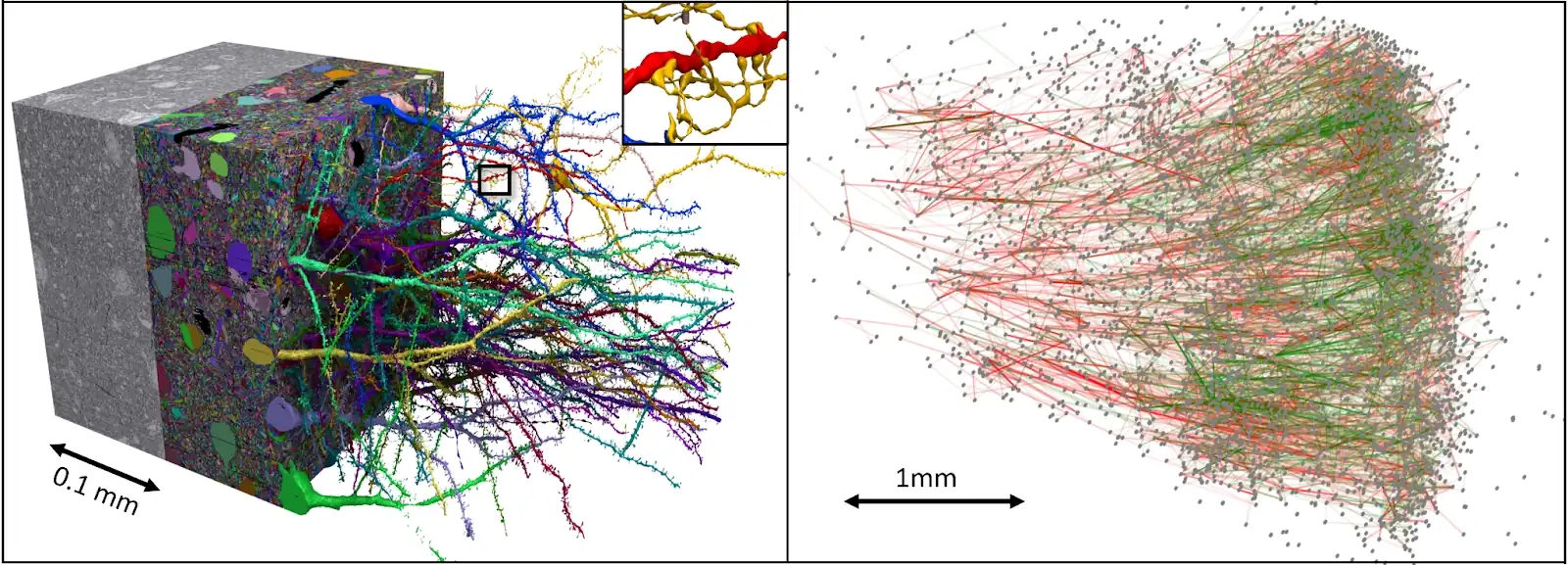
Hero image: the high-resolution H01 Connectome, a 3D reconstruction of roughly one cubic millimeter of human temporal cortex containing about 57,000 cells and 150 million synapses. Image copyright: © Google Research & Lichtman Lab (Harvard University). Renderings by D. Berger (Harvard University). Source.